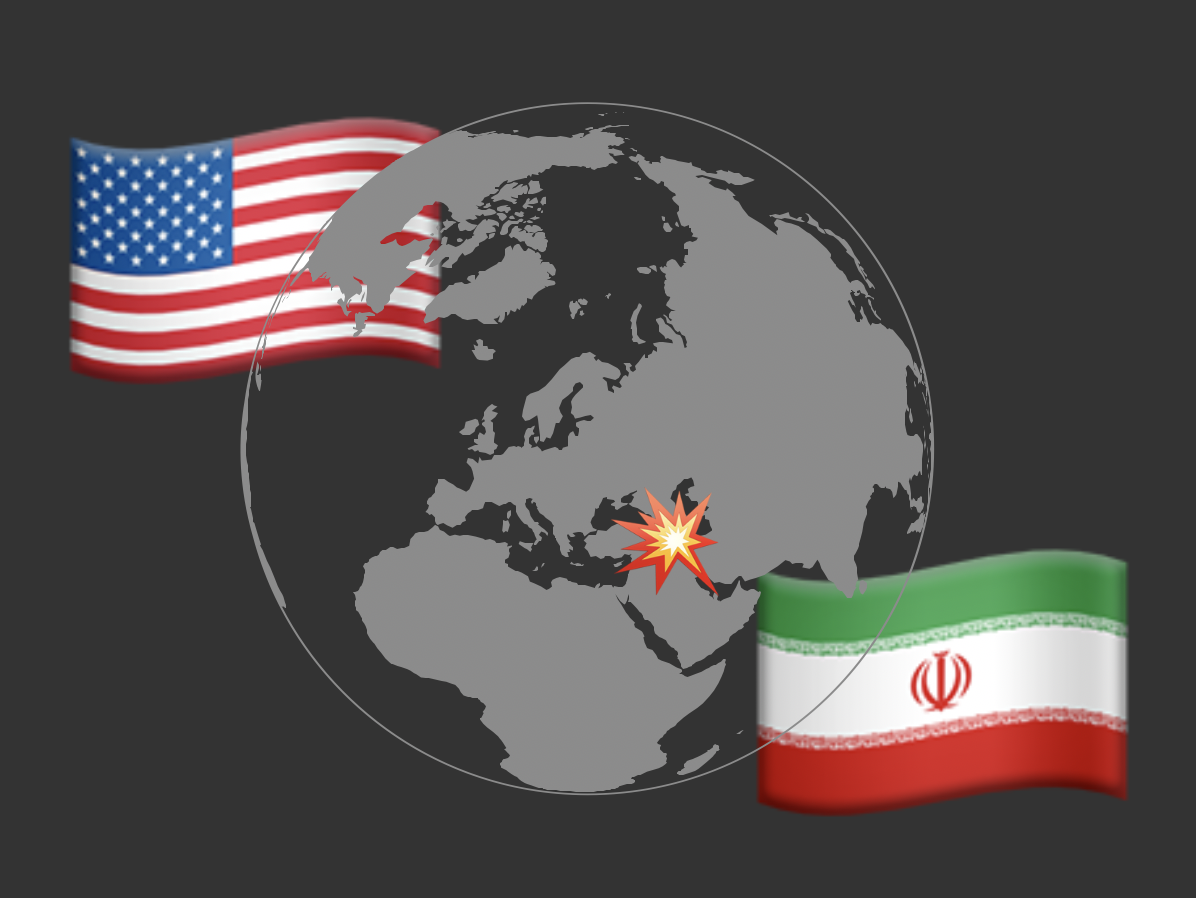
In the wake of what was very nearly a war between the United States and Iran, we need to ask ourselves how we ended up on the brink and take an uncomfortable look at what happened while we were there.
What Went Down
Background info: In 2017, Trump pulled the U.S. out of the Iran Nuclear Deal, an agreement between Iran and the U.S., the U.K., France, China, Germany, and Russia that was negotiated by President Obama in 2015 and arranged for the lifting of economic sanctions against Iran in exchange for them to ramp down their nuclear developments. The deal wasn’t perfect, but Iran was at least playing by the rules, and (for the most part) continued to do so even after the U.S. pulled out. The current conflict kicked off in May, 2019 with a report from Israeli intelligence officials that alerted the U.S. to an alleged Iranian plot to attack U.S. forces in the region, prompting the United States to send the USS Abraham Lincoln aircraft carrier to the Middle East as a reinforcement measure, leading to a month of threats between leaders of the two nations. Tensions grew worse a month later when Iran shot down a U.S. drone; they say the drone was in Iranian airspace, the U.S. claims it was over international water. Iran also bombed a Saudi oil field last September; this attack was largely unprovoked, though there was growing pressure within the country for their leaders to do something, due to the recession they were experiencing as a result of the sanctions reimposed by Trump when he pulled the U.S. out of the Iran Nuclear Deal (which caused a 75% decrease in Iranian oil exports). The attack on the Saudi oil field further damaged U.S.-Iranian relations because Saudi Arabia is a United States ally (for some reason).
December 27, 2019: A rocket attack on an Iraqi air base killed one American civilian-contractor, injured four American servicemen, and killed two Iraqis. The attack was allegedly carried out by Kata'ib Hezbollah, a military group supported by Iran.
December 29, 2019: The United States attacked five facilities in Iraq and Syria which had ties to Kata’ib Hezbollah; the attacks resulted in the deaths of at least 25 people.
December 31, 2019: An Iran-backed mob attacked the United States embassy in Baghdad, Iraq. No U.S. citizens were harmed because they were able to shelter in a safe room inside the compound, though the mob did start fires and vandalize the embassy. This prompted President Trump to deploy additional troops to Iraq.
January 3, 2020: President Trump authorizes a missile strike killing Qasem Soleimani (the second most powerful person in Iran and the figurehead of the Iranian military) at an airport in Baghdad. Trump warned Iran not to retaliate, and preemptively sent more troops the area as a precaution (at this point, 14,000 troops have been deployed to the Middle East since May, 2019).
January 4, 2020: Donald Trump threatens to attack Iranian cultural sites if they retaliate after Soleimani’s killing. Targeting cultural sites is a war crime under international law.
January 5, 2020: Secretary of Defense Mark Esper and Secretary of State Mike Pompeo have both explicitly contradicted the President’s statement that they intended to target cultural sites, leading Trump to double down on his commitment.
January 5, 2020: Iran announces that they will no longer honor the 2015 Iran Nuclear Deal, completely abandoning all the commitments they made to limit their nuclear development.
January 7, 2020: Iran attacks Iraq’s Al Asad and Erbil air bases, both of which house American troops. No casualties were reported, and Iranian officials indicated that this would be the extent of their revenge for the killing of Soleimani.
January 8, 2020: Donald Trump delivers an address announcing that the U.S. will refrain from using force in response to the 1/7/20 missile attacks, instead announcing further sanctions and encouraging other nations to withdraw from the Iran Nuclear Deal.
Things To Consider
We aren’t at war right now, and by all indications, this chapter of the saga is over. While I feel compelled to give Trump credit for showing the restraint it took to not respond to the Iranian attack on the Iraqi bases at Al Asad and Erbil with military force, that would be a bit like rewarding a toddler for safely exiting a pool after jumping into the deep end with no floaties. While the United States has had a complicated and troubled relationship with Iran for decades with more than a few points of contention, the U.S. seems responsible for exacerbating things this time. So, why did this whole thing spiral so quickly towards a war?
Simply put, it was because the Trump administration claimed that they had credible intelligence suggesting an imminent attack against Americans, and that killing Soleimani was an effort to stop it: that’s the big kickoff point for this whole thing. Yes, there were events that led up to it, but they were all pretty tit-for-tat, low consequence actions. The Soleimani strike was the headline grabbing event that really catapulted this ordeal to a much higher level.
So, was it justified? Evidence of an imminent attack has not been released, and the White House has so far refused to provide any further information. Democratic and Republican Senators have condemned the administration for providing little to no justification of their decision to kill Soleimani, after having received a briefing from the White House where they were given access to confidential details surrounding the strike (some Senators have also said that the information they receiving was not of a sensitive nature, and should be made available to the public). So, the question here is why the strike was ordered in the first place, given that it seems quite disproportionate to kill Iran’s second highest ranking official as a direct response to a far less significant attack on our Iraqi embassy where nobody was hurt.
A few potential answers to this question exist. Perhaps Trump was itching for a war. After all, he has publicly and repeatedly demonstrated in the past that starting a war with Iran is a good way to win reelection. Perhaps he wanted to distract from the impeachment proceedings at the start of the week when they could’ve potentially gotten ramped up again. Maybe he was expecting the unsavory headlines announcing that John Bolton — Trump’s previous National Security Advisor who was on the infamous Ukraine call at the heart of the impeachment inquiry — was willing to testify if subpoenaed by the Senate, and wanted to do something that take attention away from that development. However, let’s try to give Trump the benefit of the doubt, here. It’s not impossible that the action was truly taken to prevent an imminent attack against the U.S. Unfortunately, this seems less likely given that, after the White House’s briefing, even some Republicans have dismissed the intelligence on the alleged attack as being trivial and disingenuous.
Another thing that we need to ruminate upon is Trump’s willingness to commit war crimes. Soleimani’s killing, given his rank in the government of a sovereign state (and despite his role as a leader of paramilitary terrorist groups) can be categorized as an assassination and therefore a war crime in its own right. This is troubling, but it’s also a gray area. It’s easy to see that killing him wasn’t a proportionate response, but it’s hard to call it a war crime (even though it technically was) given that Soleimani has committed a long list of atrocities and certainly deserved to be taken out (a point where Democrats and Republicans seem to agree). More troubling, though, is that Trump threatened to attack Iranian targets of cultural significance. This displays a blatant disregard for international law, even while Trump’s advisors were adamantly against the idea. Yet, Trump doubled down. There’s not much we can analyze here: Trump threatened to willfully and indisputably break international law. Love him or hate him, that’s not something any voter with a conscience can ignore; it’s enough to give even the most passionate Trump fans pause.
It’s also appropriate that we acknowledge the loss of life that has transpired as a result of the actions our country has taken. Fortunately, only one American lost their life, but that’s not true for the Iranians. Soleimani’s death sent Iran into an emotional tailspin, and at least 56 people died after being trampled in a stampede at Soleimani’s huge, public, very emotional funeral procession. Additionally, 176 people died after Iran shot down a Ukrainian airliner shortly after it took off from Tehran, presumably by mistake, as a result of the heightened tensions and fear of attack that led them to more aggressively defend their airspace. I’m not saying that any of these deaths are the United States’ fault — they all boil down to Iranian government negligence — but none of those people would be dead if we hadn’t exacerbated this conflict by killing Soleimani. It’s not a great look, and our allies likely aren’t thrilled with us right now, as the plane that crashed was carrying not only Iranian citizens, but also Canadians, Brits, Germans, and Swedes.
We must also ask: are we safer? Trump said that killing Soleimani was an action taken to avoid a war, not start one. Unfortunately, one of the most significant consequences of his action against Iran was that it gave them an excuse to get out of the nuclear deal, and they’re now back to unbounded development of their nuclear program. Do you feel safer?
This whole episode is one that should cause Americans to reflect. We almost sent a bunch of nineteen year olds to war with a country who had done little to provoke such response, and for what? What did we stand to gain? What were we defending ourselves from? The American people and our allies deserve answers to those questions, and the Trump administration owes them to us. Hopefully those answers don’t lie in the lined pockets of America’s defense contractors.
UPDATED: 1/10/20, 20:21