
Deontologists Vs. Consequentialists
Vox’s Dylan Matthews looks at philosophy to explain why the whole Bernie Sanders, Joe Rogan thing turned into a controversy, and he stumbles into territory of explaining how cancel culture came to be in the first place.
Most liberals have what I would characterize as a deontological opposition to discrimination. That is, they think that discriminating against or maligning someone on the basis of membership in a protected class — women, trans people, black people, and other racially oppressed communities, etc. — violates a rule that should be inviolable. […]
The main rival to deontology is a school of thought known as “consequentialism.” In this view, the morality of actions must be judged by their consequences: The more grievous the consequences (be it in terms of human happiness, or suffering, or human freedom, etc.), the more heinous the action.
To over simplify things, you’ve got the left as the consequentialists, and the radical left as deontologists. Ignoring nuance, these schools of thought line up similarly to idealism versus realism, and they also track well with the left-to-right political spectrum.
The main objection philosophers have raised against deontological restrictions is that they’re overly rigid. Immanuel Kant, the originator of this school of moral philosophy, famously argued that it was immoral to lie in all circumstances, even to a murderer who’s asking for your friend’s whereabouts so he can kill her. Few people today think a rule that rigid is viable. But if we as a society accept more and more forms of discrimination and animus as absolutely unacceptable — adding poverty to the list, say — we are left with an ever-more-restrictive moral code that forces us into ever-thornier moral dilemmas..
Clearly, there’s a balance to be struck between consequentialism and deontology. Right now in American politics, conservatives are closer to the consequentialist POV. The radical left is balls to the wall for the deontology POV. Moderates and moderate leftists are the ones trying to figure out where that balance lies. Allow me to offer the following modified box and whisker plot as a guide for where we need to be.
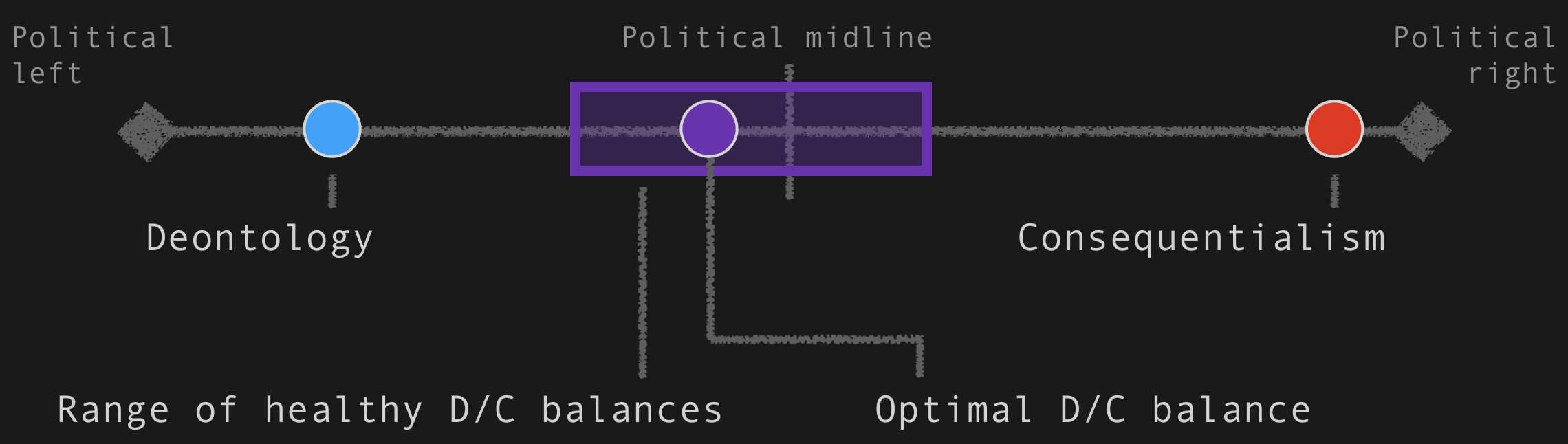
While there are more and more people joining the factions at the polar ends of this spectrum, I would assert that there are far more people in the middle than it seems. People who are on the edges (particularly in the deontology camp) are exorbitantly loud, and seem to have a much larger societal presence than they really do. Its also worth noting that the consequentialism point is further to the right than the deontology point is to the left; this placement is intentional, those on the radical left seem to adopt more aggressively deontological belief systems more than those on the equivalently radical right seem to adopt aggressively consequentialist belief systems.