Posts in Hard Hitters
Privacy Policies

I recently made a time consuming (and kinda boring) decision. Last week, I elected to delete ALL of the apps on my iPhone (except for the built in ones). This wasn’t a permanent decision, but I told myself that I wouldn’t download another app without first reading the privacy policy of the company that built it. It’s time to start actually understanding all the legal jargon we’re hastily clicking through and agreeing to.

This whole process has been enlightening in a few ways. About a week later, I still only have nine apps on my phone; I’m learning that most of the 70+ apps on my phone were just taking up space, because I’m doing just fine without most of them. I do intend to keep downloading more as I read their privacy policies, but I’m not in a hurry.

A lot of the privacy policies I’ve read so far have surprised me; some companies were way more protective of their users than I expected, and some were worse than I had dared to imagine. Check out the whole list of privacy policies I’ve read, and make your own decisions about which companies you’re comfortable giving your information to.

‘The Great Hack’

Netflix’s ”The Great Hack” is one of the best documentaries I’ve ever seen. It explains what happened with the whole Cambridge Analytica/Facebook scandal, and makes it easy to understand for those with little prior knowledge. They take a largely nonpartisan look at how these companies were able to influence the 2016 U.S. General Election, the Brexit Referendum in the U.K., and dozens of other elections in smaller countries.

It has never been clearer that the technology we all take for granted has been taking advantage of us; it is evident that data aggregated by Facebook and exploited by Cambridge Analytica has been used to effectively brainwash the public, and the tactics they’ve used were even more efficient and dangerous than the ones utilized by the propagandists of the Third Reich. Nearly all of the blame for the explosively divisive nature of those elections belongs at the feet of Alexander Nix and Mark Zuckerberg.

“The Great Hack” very well may be the most important film of the decade, and I urge everyone to watch it. Make a concerted effort to be open minded, and don’t immediately rule out the possibility that these companies may have pulled one over on you—it’s easy to dismiss their alleged wrongdoings on the basis of “well if anyone had convinced me to think one way or the other, I think I would know.” The problem is that many people do dismiss it on those grounds, but by the very nature of what they’ve done, nobody could know until it’s too late. These are companies with billions of dollars at their disposal and a team of scientists who possess deep knowledge of how the human brain works—there is no shame in admitting they may have duped you. They certainly got me. What’s most important is what we do now that we know what they’ve done.

I’ve been pounding the #deletefacebook drum since well before the scandal broke, and there has never been a better time to get out of their corrosive network: delete your Facebook account. However, even that isn’t enough at this point.

The safety and integrity of every democracy on earth depends on everyone understanding what these companies did and calling upon our representatives to finally limit the boundless power that big tech companies have over our data. If those things don’t happen, the world will never see another free and fair election.

#deletefacebook

See also: “The Social Dilemma”

I Have Decided To Stop Being Gay

With the omnipresence of identity politics in today’s society, personal identifiers and labels are playing a larger role than ever in how people understand each other. Personally, I think this is bad in almost all cases, and it’s why I’ve recently been experimenting with the idea of simply refusing to adopt the labels society says I’m supposed to carry. I have decided to stop being “gay.”

Starting now and continuing for the foreseeable future, I am not going to use the word “gay” when describing myself, nor the word “queer,” which I personally have never liked anyway; it’s a phonetically weak word which has such a broad definition that it is hardly useful (and on top of all that, it used to be an insult). Please note that this does not mean that I am now any less attracted to men than I have been since I was three years old; you cannot change your sexuality, and frankly, why would I? Men are the bomb.

Instead of calling myself “gay,” if my sexuality becomes relevant to a conversation, it is easily and more clearly described by short, simple, non-confusing, nonthreatening phrases such as “I prefer men," “I’m into dudes," or “I’m attracted to guys.”

The way I see it, my decision to shed the “gay” label flows in the same vein as the current move to adopt person-first language when referring to individuals with disabilities. For example, it’s considered more appropriate to say “a child with autism” than it is to say “an autistic child.” The point is to literally put the person first in the sentence, so that the first impression is of the individual rather than the condition. It’s the difference between describing and defining.

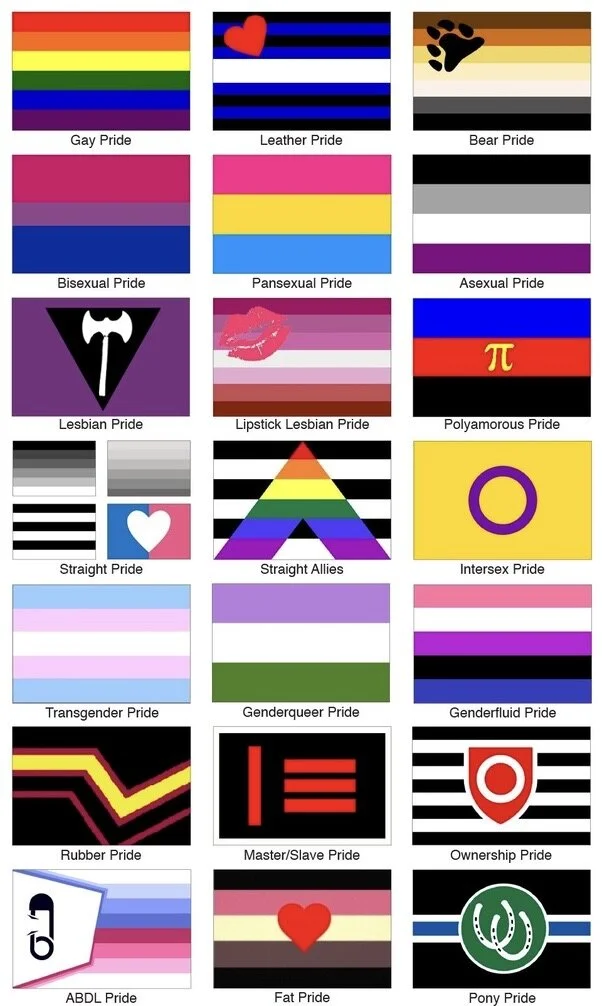
Some of the various “pride” flags adopted by the LGBTQIAPEMDAS+ community.

Some of the various “pride” flags adopted by the LGBTQIAPEMDAS+ community.

Defining is exactly the problem here. The more labels we create for ourselves, the more labels that can be weaponized and used to alienate us from the rest of society. And boy, do we like labeling ourselves—the acronym is like 19 letters long now, while it was only three letters just a few short years ago. We went from LGB to LGBTQIDGAFLMNOP+, or whatever the hell it is this week. Too many people have allowed themselves to be defined by these labels, and in doing so, they’re providing ammunition for those who seek to limit their personal freedoms and civil rights.


Still, there is some amount of criticism that could be made regarding my decision to abandon the “gay” label, but these concerns are easily addressed.

Some of my fans have said that my decision to stop using the words “gay” and “queer” is predicated on years of internalized homophobia and self-hatred, but those people clearly don’t know me well, because in reality I am one cocky son of a bitch who is usually all too pleased with himself.

Another common point brought up when I assert the uselessness of labeling sexuality is a defense of the labels’ abilities to facilitate the forming of communities. This is not a very strong argument for a few reasons. 

  1. The “Gay Community” as we understand it now didn’t exist at all until roughly fifty years ago; it is an extremely new phenomenon in human history. Furthermore, the “gay” identity itself, where someone is characterized by their same-sex attraction, really only began to form in the 1920s.

  2. I personally find no value in the “Gay Community.” Gay men have a terrible habit of becoming catty, dramatic, petty, hateful, spiteful, etc. when they congregate, and this is far from a welcoming environment. If there’s any benefit to being gay, it would be that you get to avoid the drama stereotypically associated with dating women, but nope. The “Gay Community” chews up that idea and spits out tenfold the drama, just with more testosterone. 

  3. If finding a community is so essential to people, they should look for one that will accept them regardless of their sexuality, not because of it. If all you have in common with someone is your sexuality, how much social value does that truly offer?

The last major case made against my decision to drop these labels suggests that by refusing to use the word “gay," I won’t be contributing to the deconstruction of the stereotypes that plague same-sex attracted men—I’ve given this lot of thought, and my conclusion is that it’s horse shit. Words like “gay” and “queer” are nearly synonymous with the stereotype of weak, twinky, feminine, ultra-liberal white boys who are obsessed with their sexuality, and they’re so closely tied that it would take decades to dissociate them. However, the simpler phrases I intend to utilize going forward would allow us to easily shed the negative connotations of the tired “gay” and “queer” labels, which would in turn make the coming out process easier for a lot of the more masculine, straight-seeming guys who are currently choosing to remain closeted because they don’t want to be unfairly labeled as weak or feminine on account of a single unchangeable aspect of their personality (who could blame them?). 

If anything, I think using other terms to describe sexuality WILL help to deconstruct said stereotypes, because it would clearly demonstrate that there is a portion of the same-sex attracted population for whom their same-sex attraction does not define their personality, which would be helpful in quelling stupid assumptions that people chose to be gay for attention (or any other reason). This is essential because it has the potential to have a domino effect, where closeted guys would see more and more men who don’t deny their same-sex attractions but also don’t fit the sassy, limp-wristed stereotype, and would therefore begin to feel more comfortable being open about their own same-sex attractions because they wouldn’t feel pressured to conform to a stereotype that doesn’t truly reflect their personality.

What’s really going to put prejudice and stereotypes to bed is when more of those straight-seeming guys come out, in the process shocking all the ignorant people who don’t think they’ve ever met a same-sex attracted person (all the Bible thumpers whining “dont hate the sinner, hate the sin”), and showing them that far more of us exist around them than they think. This could easily take a turn down a theological path here, but don’t worry, I won’t go there. Yet.


The time has come to retire these labels. They only serve to alienate us from the rest of society, and make it more difficult for a lot of struggling young men to come to terms with their same-sex attractions. 

In conclusion, labels are gay.

Memorial Day Musings

After spending Memorial Day weekend at the beach enjoying the many freedoms afforded to me by the sacrifices of countless brave men and women from the past 300+ years of American history, a few thoughts come to mind. First and foremost, thank you to all those who serve our country.

As we reflect on their sacrifices this Memorial Day, it is also important to remember why some of those sacrifices were made, and engage in some uncomfortable dialogue about the United States Military’s history.

In many cases, particularly in the last 70 years, it seems that the United States government has taken advantage of the commitments made by our troops. There are plenty of examples of the United States utilizing military force where it was less than necessary, in some cases as a result of completely fabricated stories involving unproven threats to our national security. This heinous abuse of power must be called out when it occurs, and we must demand better of our leaders than to use our troops as pawns for their own political agendas. We need to respect these brave men and women enough to only ask them to defend our country when it is truly necessitated.

It is essential that the American public wisen up and do a better job of calling out our leaders when they prematurely threaten military action as a solution to a problem, as is currently happening with the conflicts in Iran, Venzuela, and the US-Mexican border. We have to put an end to the pattern of engaging in endless wars that result in thousands of troops laying down their lives because the civilians are too ignorant and apathetic to call out our government when they deploy our troops without just cause. Military force should only be utilized when we have stone cold proof that it is the only way to resolve a direct threat to our national security, anything else is disrespectful to our troops and their families.

The Shady Reality of Facebook's Shadow Profiles

Most people who know me have heard me complain relentlessly about Facebook at some point, and anyone who doesn’t know me will recognize quickly upon meeting me that I believe Facebook is one of the most dangerous, corrupt, malicious companies in the world. This is a personal account that will help to illustrate why.

I deleted my Facebook account in 2017 after reading a series of articles that pulled back the curtain on their dishonest, predatory practices in regards to mishandling user data and disregarding privacy, often in undeniably intentional ways. One of these many ways included the use of “shadow profiles”,  which are unseen profiles with a wealth of information created internally by Facebook. They are created not only for people who use their services, but also for people who have never used Facebook before. These shadow profiles help Facebook improve their network of users to recommend more relevant friend requests, ads, timeline posts, etc. The problem with this was that nobody had any idea Facebook had made these shadow profiles, as they intentionally kept it a secret. Additionally, they provide no opt-out option or any way to truly remove your data from these shadow profiles; they are entirely beyond consumer access, and were created and maintained regardless of consumer consent.

This all sounds a bit Orwellian, but before you recommend I get fitted for a tinfoil hat, consider this very personal, very true account that proves the existence of Facebook’s shadow profiles.

After I deleted my Facebook account in 2017, they promised to delete my account and the associated data within 90 days. Seeing as I had no way to verify that this would happen, I tried to forget about it, and eventually made peace with the fact that even if they didn’t delete my information, I had done all I could do. Fast forward two years to the present, and I am only more distressed about how Facebook is operating. From the Cambridge Analytica scandal, to the multitude of uncovered lies and privacy debacles, I truly think they’re a criminal enterprise ran by a few greedy people who are so obsessed with their own corporate and personal wellbeing, that they are willing to destroy free speech and democracy in order to preserve themselves. I’ve increasingly felt like I should be doing more to start conversations about how corrupt they are, and I have tried diligently to get others to delete their accounts, too. In fact, CopyrightBro exists largely because I wanted a place to share my ideas, but couldn’t stomach the idea of contributing to the overall success of their operation by publishing (what I consider to be) meaningful ideas in a place where they would get mixed in with useless gender reveal videos and cat memes as a way to placate, entertain, and enslave the millions of ignorant people on whom Facebook relies for advertisement revenue.

Nevertheless, I decided it would be worth it to create a Facebook page for CopyrightBro so that people could see my (specifically anti-Facebook) posts, and I just wouldn’t create a page for Broc Gantt. It turns out, Facebook won’t let you make a business page without first creating a personal profile, so I begrudgingly entered my name and phone number, but refused ALL of the optional information (profile photo, email, etc). Despite this, the third screen Facebook showed me during the account creation process was a screen where they explained how to add friends, followed by a scrolling list of people I know from every area of my life. Family members, high school friends, old work friends, people from college, previous church members, and folks from the local community. They conveniently offered to fill in my high school and college information, as well as offered up my hometown as a suggested location to add to my profile. I knew almost every single person they recommended, and all of the other information about my schools and hometown was spot on. Ultimately, I have decided not to create an account for myself or CopyrightBro.

The bottom line is this: there is no way Facebook could recommend all of that information solely based on the name and phone number of a new user (remember, my account had been permanently deleted two years prior, and they promised to delete all the associated data). The evidence for their utilization of shadow profiles is incontrovertible, and it is a practice that absolutely must come to an end. It is mass-market stalking.

If you’d like to learn more about shadow profiles, I’d recommend checking out this article from The Verge. Of course, I’d also recommend deleting your Facebook profile, but if you can’t yet bring yourself to delete it, share this post, and maybe you can help someone else make the decision. If you’d like help making your decision, spend some more time on CopyrightBro, and I’ll do my best to convince you. Start with my comments on this article about all of Facebook’s lies and coverups.

#deletefacebook