
I Have Decided To Stop Being Gay
With the omnipresence of identity politics in today’s society, personal identifiers and labels are playing a larger role than ever in how people understand each other. Personally, I think this is bad in almost all cases, and it’s why I’ve recently been experimenting with the idea of simply refusing to adopt the labels society says I’m supposed to carry. I have decided to stop being “gay.”
Starting now and continuing for the foreseeable future, I am not going to use the word “gay” when describing myself, nor the word “queer,” which I personally have never liked anyway; it’s a phonetically weak word which has such a broad definition that it is hardly useful (and on top of all that, it used to be an insult). Please note that this does not mean that I am now any less attracted to men than I have been since I was three years old; you cannot change your sexuality, and frankly, why would I? Men are the bomb.
Instead of calling myself “gay,” if my sexuality becomes relevant to a conversation, it is easily and more clearly described by short, simple, non-confusing, nonthreatening phrases such as “I prefer men," “I’m into dudes," or “I’m attracted to guys.”
The way I see it, my decision to shed the “gay” label flows in the same vein as the current move to adopt person-first language when referring to individuals with disabilities. For example, it’s considered more appropriate to say “a child with autism” than it is to say “an autistic child.” The point is to literally put the person first in the sentence, so that the first impression is of the individual rather than the condition. It’s the difference between describing and defining.
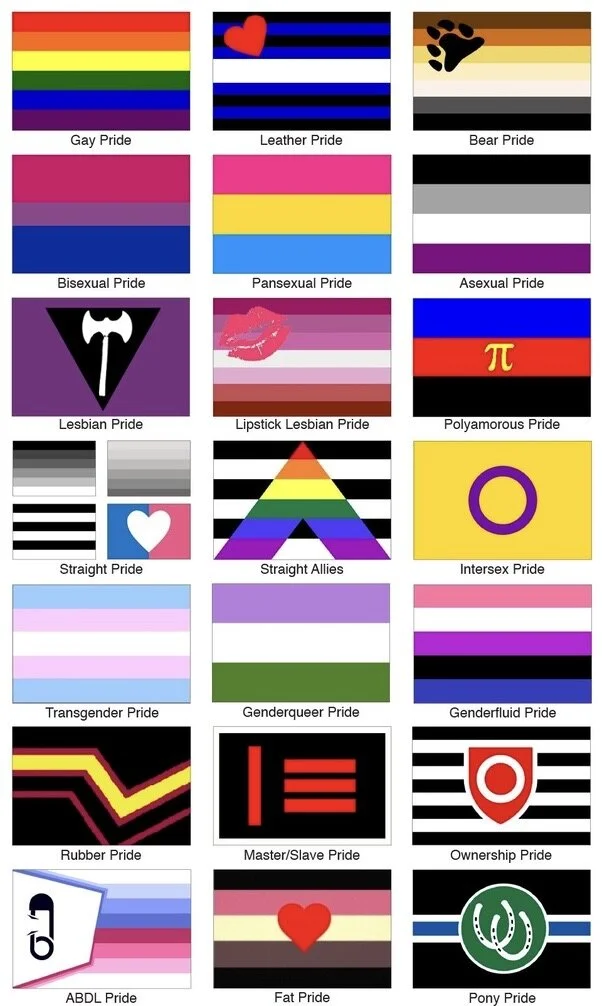
Some of the various “pride” flags adopted by the LGBTQIAPEMDAS+ community.
Defining is exactly the problem here. The more labels we create for ourselves, the more labels that can be weaponized and used to alienate us from the rest of society. And boy, do we like labeling ourselves—the acronym is like 19 letters long now, while it was only three letters just a few short years ago. We went from LGB to LGBTQIDGAFLMNOP+, or whatever the hell it is this week. Too many people have allowed themselves to be defined by these labels, and in doing so, they’re providing ammunition for those who seek to limit their personal freedoms and civil rights.
Still, there is some amount of criticism that could be made regarding my decision to abandon the “gay” label, but these concerns are easily addressed.
Some of my fans have said that my decision to stop using the words “gay” and “queer” is predicated on years of internalized homophobia and self-hatred, but those people clearly don’t know me well, because in reality I am one cocky son of a bitch who is usually all too pleased with himself.
Another common point brought up when I assert the uselessness of labeling sexuality is a defense of the labels’ abilities to facilitate the forming of communities. This is not a very strong argument for a few reasons.
The “Gay Community” as we understand it now didn’t exist at all until roughly fifty years ago; it is an extremely new phenomenon in human history. Furthermore, the “gay” identity itself, where someone is characterized by their same-sex attraction, really only began to form in the 1920s.
I personally find no value in the “Gay Community.” Gay men have a terrible habit of becoming catty, dramatic, petty, hateful, spiteful, etc. when they congregate, and this is far from a welcoming environment. If there’s any benefit to being gay, it would be that you get to avoid the drama stereotypically associated with dating women, but nope. The “Gay Community” chews up that idea and spits out tenfold the drama, just with more testosterone.
If finding a community is so essential to people, they should look for one that will accept them regardless of their sexuality, not because of it. If all you have in common with someone is your sexuality, how much social value does that truly offer?
The last major case made against my decision to drop these labels suggests that by refusing to use the word “gay," I won’t be contributing to the deconstruction of the stereotypes that plague same-sex attracted men—I’ve given this lot of thought, and my conclusion is that it’s horse shit. Words like “gay” and “queer” are nearly synonymous with the stereotype of weak, twinky, feminine, ultra-liberal white boys who are obsessed with their sexuality, and they’re so closely tied that it would take decades to dissociate them. However, the simpler phrases I intend to utilize going forward would allow us to easily shed the negative connotations of the tired “gay” and “queer” labels, which would in turn make the coming out process easier for a lot of the more masculine, straight-seeming guys who are currently choosing to remain closeted because they don’t want to be unfairly labeled as weak or feminine on account of a single unchangeable aspect of their personality (who could blame them?).
If anything, I think using other terms to describe sexuality WILL help to deconstruct said stereotypes, because it would clearly demonstrate that there is a portion of the same-sex attracted population for whom their same-sex attraction does not define their personality, which would be helpful in quelling stupid assumptions that people chose to be gay for attention (or any other reason). This is essential because it has the potential to have a domino effect, where closeted guys would see more and more men who don’t deny their same-sex attractions but also don’t fit the sassy, limp-wristed stereotype, and would therefore begin to feel more comfortable being open about their own same-sex attractions because they wouldn’t feel pressured to conform to a stereotype that doesn’t truly reflect their personality.
What’s really going to put prejudice and stereotypes to bed is when more of those straight-seeming guys come out, in the process shocking all the ignorant people who don’t think they’ve ever met a same-sex attracted person (all the Bible thumpers whining “dont hate the sinner, hate the sin”), and showing them that far more of us exist around them than they think. This could easily take a turn down a theological path here, but don’t worry, I won’t go there. Yet.
The time has come to retire these labels. They only serve to alienate us from the rest of society, and make it more difficult for a lot of struggling young men to come to terms with their same-sex attractions.
In conclusion, labels are gay.