How much do you want to bet it’s a white guy?
How much do you want to bet that if it is a white guy, the president, right wing congressional leaders, nor the mainstream news outlets will call him a “terrorist”?

How much do you want to bet it’s a white guy?
How much do you want to bet that if it is a white guy, the president, right wing congressional leaders, nor the mainstream news outlets will call him a “terrorist”?
A key measure in the NDAA to which Trump objects is the move to rename US military bases currently named for leaders of the Confederacy, which seceded from the union over slavery, leading to the civil war of 1861 to 1865.
Pressure to rename the bases grew this year amid nationwide protests over the killing by Minneapolis police of George Floyd […]
Trump also threatened a veto if the bill did not repeal part of a 1996 telecoms law which prevents online companies from being sued in relation to third-party content.
If Section 230 is not “completely terminated”, Trump tweeted earlier this month, “I will be forced to unequivocally VETO the Bill when sent to the very beautiful Resolute desk.”
[…]
The Senate backed the bill 84-13, with the no votes coming from some of the most conservative Republicans and most liberal Democrats. The Democratic-led House backed the NDAA by 335-78, with some “no” votes also coming from liberal Democrats less likely to back a Trump veto.
The NDAA determines everything from how many ships are bought to soldiers’ pay to how to address geopolitical threats. The measure vetoed by Trump was a compromise, combining separate measures already passed in the House and Senate.
Lawmakers take pride in the bill having become law every year since 1961, saying it reflects their support for the military. Trump’s veto, if upheld, would delay a 3% pay raise for active-duty troops.
Donald Trump, bone spur survivor and champion of veterans everywhere.
I bet if you polled active duty service members, you’d find that they’d overwhelmingly want this bill (which gives them a raise) signed into law. Donald Trump is a selfish prick: this is all about catering to his base of racists, both the part about not wanting to rename military bases and the part about wanting social media companies to be held legally responsible when their users say mean things about them. Talk about snowflakes.
I guess we’re taking “Buzzfeed News” seriously now? Whatever. Craig Silverman and Ryan Mac, reporting for Buzzfeed News:
[…]Facebook employees complained about what they called a self-serving campaign that bordered on hypocrisy, according to internal comments and audio of a presentation to workers that were obtained by BuzzFeed News. A change in Apple’s iOS 14 mobile operating system — which requires iPhone owners to opt in to allow companies to track them across other apps and websites — hurts Facebook, some employees argued on the company’s private message boards, and their employer was just using small businesses as a shield. […]
“It feels like we are trying to justify doing a bad thing by hiding behind people with a sympathetic message,” one engineer wrote […]
Several employees seemed unconvinced by the presentation. Some did not understand how Apple’s changes would negatively affect small businesses, while one said Facebook’s attempt to undermine Apple’s privacy policy made it “a traditional trojan virus.” […]
“The only thing I’m hearing, again and again, is ‘this is bad for the businesses,’ and I’d really like someone at the top to explicitly say, ‘People are better off if they don’t know what we’re doing, if we don’t have to explain ourselves to them, if they don’t get a choice to opt in or opt out of our practices, if we obscure it as much as possible behind interesting features and then get them to accept surreptitious tracking on the back end as long as we downplay it,’” they wrote
I’m glad these individuals are speaking up about how shitty Facebook’s tracking practices are, but where have their voices been for the past decade? They’re way late to the party; they aren’t heroes, they’re squeamish accomplices.
Isabel Kershner, reporting for The New York Times:
Israel’s government collapsed Tuesday, pushing the country into yet another early election — the fourth in two years.
The Israeli Parliament dissolved itself at midnight on Tuesday. The move forced a new election after weeks of infighting and paralysis in the so-called unity government, an uneasy coalition sworn in just seven months ago
What a shit show. Israel was a fun little post-WW2 experiment that seems to have run its course. They spent a few decades feeling victimized and pretending to be a country, but the whole time, they were just stirring the Middle Eastern pot. One starts to think maybe the #freepalestine people have a point. Granted, everyone in that region has been fighting for thousands of years over who gets to play in what sandbox according to which invisible sky wizard, so frankly, fuck all of them. I’m sick of America sending our troops over there to die trying to break up their pointless, unending wars (or just join them for profit, where the military industrial complex is involved).
Conservative Christians get so caught up in their allegiance to Israel, I really don’t get it. The Jews were “God’s Chosen People” is usually the best answer they can come up with, but I thought God loved everyone? If the Jews really are the favorites, why the hell would you subscribe to a religion where your god says you’re second best? What a joke.
The possibility of touchscreen Macs coming to market in the next handful of years is a hot topic with a lot of intense debate, and I want to add my thoughts to the discourse about what I think Apple will do and what I would like Apple to do.
I think Apple is going to introduce Macs with touchscreens the next time they update the physical design, likely in late 2021 or 2022. I was curious if they would introduce touch screens when they announced the M1 Macs, but in hindsight, it wouldn’t have made a ton of sense.
For argument’s sake, let’s presume that Apple always knew that within the next two years or so that they were going to 1. transition to Apple Silicon chips, 2. update the physical design of the MacBook Pro (which has been the same since 2016) and possibly the MacBook Air (which has been the same since 2018), and 3. add touchscreens. That’s a lot of advancements. And as difficult as it is to get sustained attention in today’s media environment, I think it makes sense from a marketing perspective that they would try to time these advancements to give them the most positive coverage as possible. Given how powerful and efficient the M1 is, it seems obvious that Apple knew beforehand that they would get a lot of great press when they released machines that used it, regardless of whether the machines looked the same on the outside or not. That’s exactly what happened. The other two changes, however, had the potential to feel cosmetic (in the case of the physical design update) and overdue and gimmicky (in the case of touchscreens), if they were to incorporate those features asynchronously. To me, it seems like the best way to roll out those three updates would be to first put out the new chips, let people “oooh” and “aaah” over them, and use the next year or so to iron out any kinks. Then, a year or two later, release machines with a new form factor and touchscreen support, completely ushering in a new era of Mac hardware, and reap the media coverage benefits of a new design and a new input method at the same time.
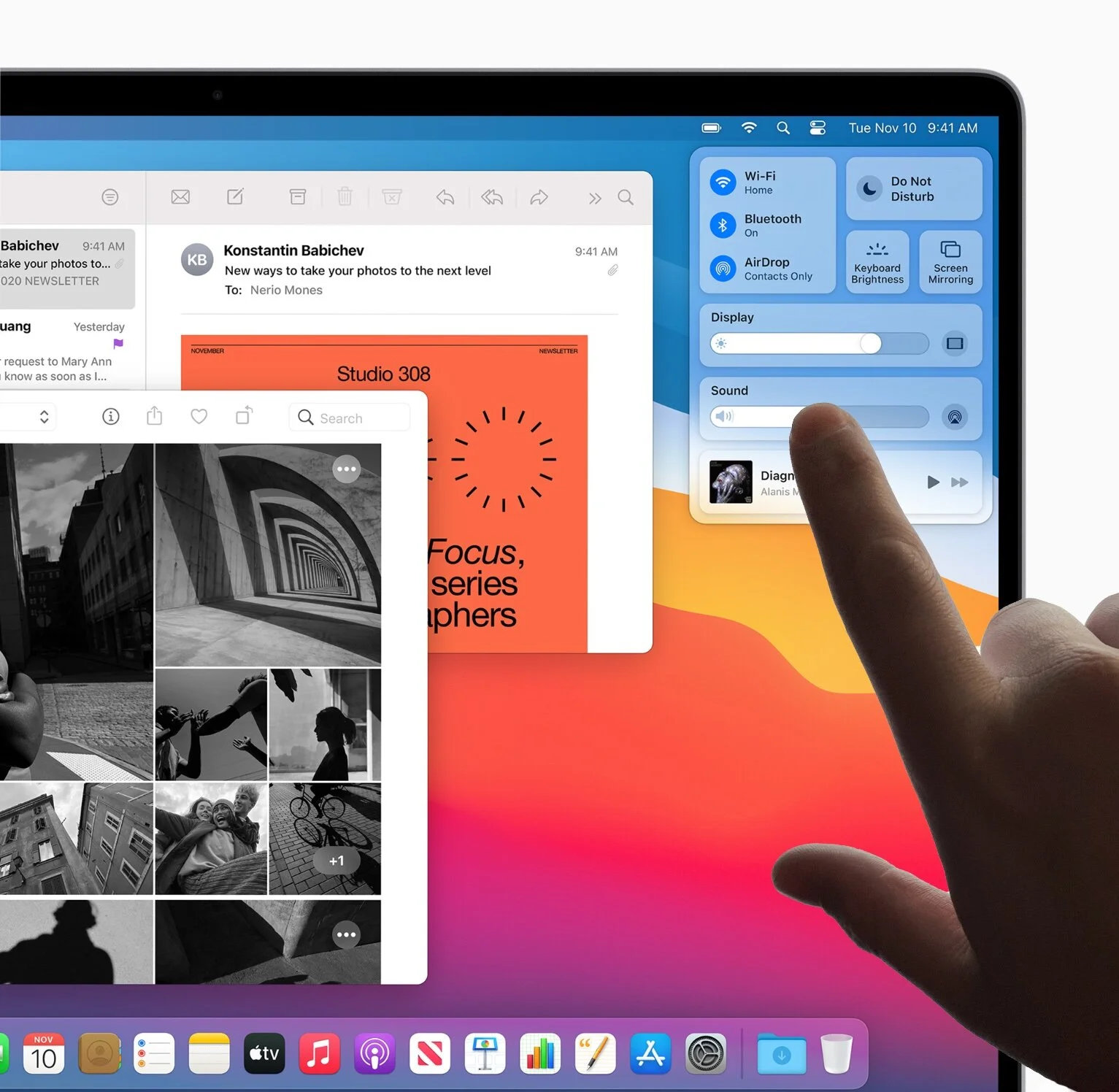
There are a few breadcrumbs I point to as indicators that this is probably Apple’s plan, namely the updated UI elements in macOS Big Sur. I know, I know, Craig Federighi has said that they didn’t even consider touchscreen support when redesigning some interface elements, but of course he said that. The truth is that elements like the Control Center, the straight-from-iOS widgets, and the new, rounded-off-square app icons are all begging to be poked by a crude, imprecise finger, as opposed to clicked by a nimble little cursor. Frankly, if they weren't designed for touch, then they’re just unattractive and inefficient, wasting display real estate (particularly Control Center, they could’ve fit so many more toggles and checkboxes in there if they were appropriately sized for manipulation with a cursor).
As far as what I would like for Apple to do: I want them to add touchscreens.
Now, I understand the concern that touchscreen Macs would have to go through some rather extensive UI redesigns to make the whole operating system navigable via touch. For a while, I was solidly on the team who never wanted touchscreen Macs. After all, pretty much all touchscreen laptops suck, and it’s uncomfortable to spend any amount of time with your arm hovering in the air to touch a vertical pane. But just because other companies couldn’t do something well doesn’t mean Apple can’t come right in and eat their lunch, “best not first” is Apple’s whole schtick. But the fact that touchscreen laptops are uncomfortable and finicky to use is not at all the point. Many PC manufacturers really put their eggs in the touchscreen basket, and they positioned their touchscreen machines in a very gimmicky way and created so much (undeserved) hype that made it seem like you were supposed to use your finger to control them all the time.
Apple knows the Mac is at it’s most powerful as a cursor-first device, and they won’t try to change that any time soon for a brief spell of good advertising fortune. I think they love the Mac as it is, but I think they recognize that they can make it better by allowing people to use their fingers to interact with the Mac when it feels natural. Not everything needs to be done with a finger, and redesigning the entire UI to that end would waste tons of screen real estate and slow down most users. But they could redesign a few things without harming the experience, and the convenience of being able to touch the screen would provide more value than it would cost.
When I first tried the iPad Pro Magic Keyboard, I was skeptical about cursor support on a device that was always designed for Touch. The truth is, it’s not a perfect experience. There are instances where the cursor seems too small and slow, and where my finger could whip around the operating system with a lot more ease. But it does have its advantages: for example, selecting text is far more convenient with a cursor. The situation would be similar on the Mac. Using your finger all the time wouldn’t be a perfect experience, but for simple gestures like scrolling or tapping an app icon, it can be a lot faster and more convenient. In fact, since I bought the iPad Pro Magic Keyboard, my use of my iPad has increased by a factor of ten, seriously. I’m so used to it that on a weekly basis now, I embarrass myself by reaching up to touch the screen of my Mac. It’s not that I don’t like my Mac and have therefore made a conscious choice to use the iPad instead, it’s just that it offers me more input methods that give me greater flexibility to manipulate small on-screen objects with precision and still enjoy the convenience and expediency of swiping and tapping the screen with a finger. More input methods has directly led to fewer annoyances when interacting with the device, and I think the Mac could enjoy the same (inverse) benefits.
I’ve listened to a few episodes of the “Noble Blood” podcast, and this episode about the King Edward II of England, and his lover Piers Gaveston is really fascinating. It reminds me a bit of Renly Baratheon and Loras Tyrell from Game of Thrones.
Also worth noting: the host does a great job of contextualizing same sex relationships during the thirteenth and fourteenth centuries, before that predisposition was given a label and took on an entire identity. Men today often seem compelled to perform a particular lifestyle upon acknowledging their same sex attractions, but that’s actually a very recent phenomenon, and prior to a few decades ago, that wasn’t the case at all. I’m glad the host took the time to make sure listeners understand that while we have labels for men in positions similar to Edward II and Piers Gaveston, they did not define themselves in this way.
It’s a fascinating story, and well worth a listen.
Drew Harwell and Ellen Nakashima, reporting for The Washington Post:
A security executive with the video-tech giant Zoom worked with the Chinese government to terminate Americans’ accounts and disrupt video calls about the 1989 massacre of pro-democracy activists in Tiananmen Square, Justice Department prosecutors said Friday.
[…]
Prosecutors said the China-based executive, Xinjiang Jin, worked as Zoom’s primary liaison with Chinese law enforcement and intelligence services, sharing user information and terminating video calls at the Chinese government’s request.
Jin monitored Zoom’s video system for discussions of political and religious topics deemed unacceptable by China’s ruling Communist Party, the complaint states, and he gave government officials the names, email addresses and other sensitive information of users, even those outside China.
We’ve known Zoom has plenty of issues for a while now, but this is outrageous. Where is our strongman president when foreign adversaries are directly impeding American citizens’ freedom of speech? He’s made a huge issue about social media companies and their alleged censorship of conservative voices (which is bullshit), but now that there’s real censorship of Americans by China, he’s silent, either too stupid to understand what’s going on, too selfish to care, or so pathetic that he’s still nursing his post-election wounds.
The first amendment was designed to protect Americans against government overreach, but I never imagined we would have our first amendment rights challenged or stripped away by another government than our own. There has to be consequences for this.
Rob Price, writing for Business Insider earlier this year:
In an email to Facebook's chief financial officer at the time, Zuckerberg said Facebook wanted to buy Instagram to give itself more time to fend off competitors.
"One way of looking at this is that what we're really buying is time. Even if some new competitors springs up, buying Instagram, Path, Foursquare, etc now will give us a year or more to integrate their dynamics before anyone can get close to their scale again," he wrote. "Within that time, if we incorporate the social mechanics they were using, those new products won't get much traction since we'll already have their mechanics deployed at scale."
Isobel Asher Hamilton, Katie Canales, and Paige Leskin, reporting for Business Insider last week:
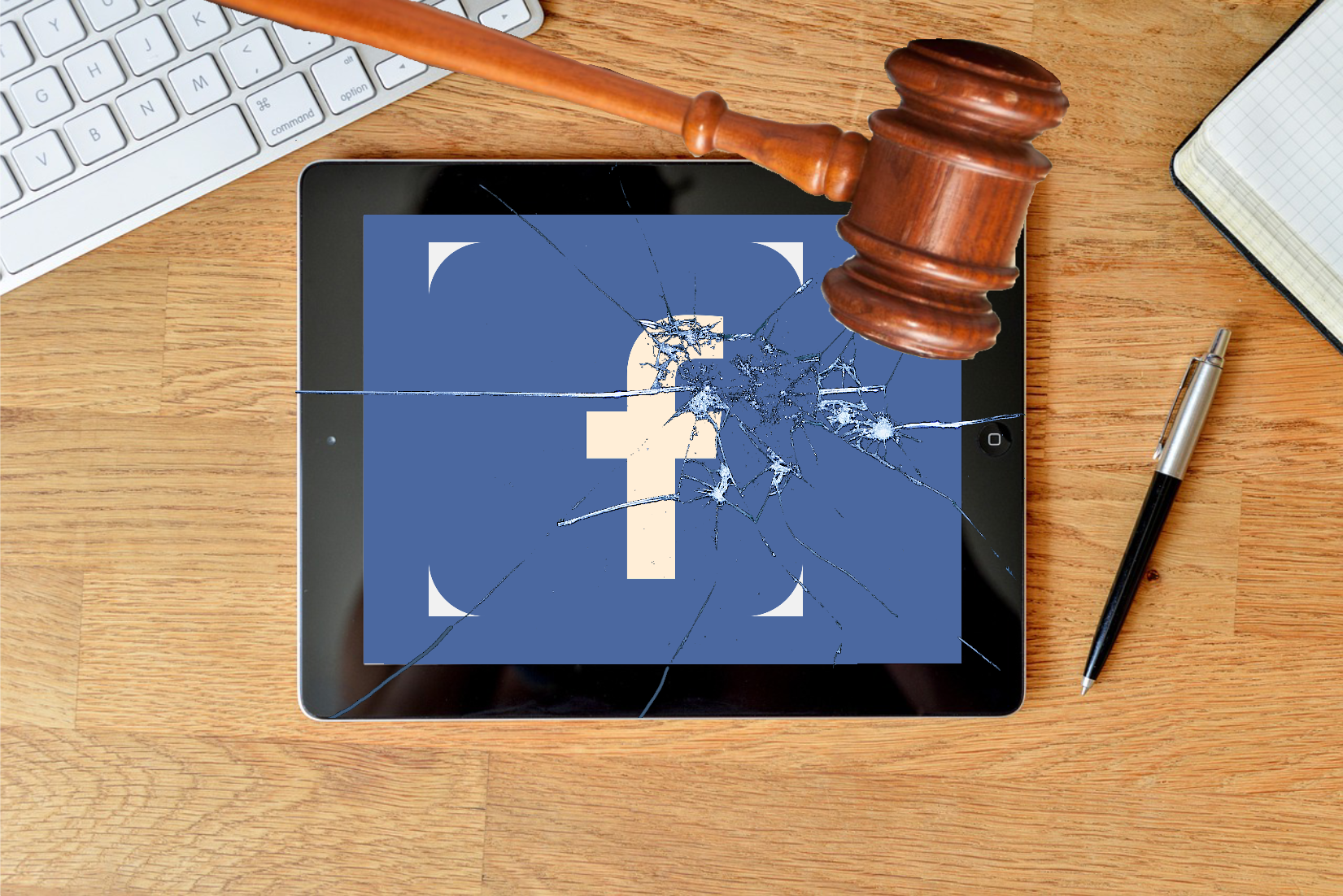
The lawsuits allege that Facebook used a strategy of neutralizing competitors before they could threaten the company's dominance of the social-media market. The suits call out Facebook's decisions to buy rather than compete with Instagram and WhatsApp, and they allege it imposed "anticompetitive conditions" on software developers.
Both complaints seek a "divestiture of assets" for Facebook — that is, breaking off Instagram and WhatsApp from the social-media giant. Additionally, Facebook could be required to get approval from the government before any mergers or acquisitions in the future.
[…]
The coalition of attorneys general, led by New York Attorney General Letitia James, began an investigation into Facebook in September 2019, and the FTC subsequently joined. Attorneys general from 46 states as well as Washington, DC, and Guam have signed on to the lawsuit. The only states whose attorneys general have not signed on are Alabama, Georgia, South Carolina, and South Dakota.
Forty six states. That’s more than enough to pass a constitutional amendment. Facebook is about to get fucked up.
This investigation (and any resulting regulation) is clearly focusing on antitrust issues, but I sincerely hope that congressional leaders take a long hard look at Facebook’s privacy practices while they’ve got them under the microscope.
I hope Facebook gets what they deserve for capitalizing on the destruction of privacy and the polarization of the American people.
Hartley Carlton, reporting for MacRumors:
Facebook has today attacked Apple in a series of full-page newspaper ads, asserting that iOS 14's privacy changes regarding data gathering and targeted advertising are bad for small businesses (via Bloomberg).
The ads are running in the New York Times, Wall Street Journal, and Washington Post, feature the headline "We're standing up to Apple for small businesses everywhere."
Earlier this year, Apple introduced a number of privacy changes that curb the ability of companies like Facebook to gather data on users and target adverts. In iOS 14, Apple has made the "Identifier for Advertisers," used by Facebook and its advertising partners for ad targeting, an opt-in feature, providing more transparency for users who would prefer not to be tracked in apps and on websites. The update simply asks users if they want to agree to ad tracking or prevent cross-app and cross-site tracking to provide targeted ads.
I was going to post the text of the ad and pick it apart line by line, but it would be a waste of time. Facebook has committed a logical fallacy, completely misrepresenting what Apple has chosen to do (which is give people more control over what data they share with big companies) as some sort of offensive play against small businesses. It’s a strawman argument designed to make small businesses look like the victims of Apple’s “forced software update”.
John Gruber recently wrote about this on Daring Fireball, again making the salient point that the privacy issue boils down to entitlement:
The entitlement of these fuckers is just off the charts. They have zero right, none, to the tracking they’ve been getting away with. We, as a society, have implicitly accepted it because we never really noticed it. You, the user, have no way of seeing it happen. Our brains are naturally attuned to detect and viscerally reject, with outrage and alarm, real-world intrusions into our privacy. Real-world marketers could never get away with tracking us like online marketers do.
This so clearly isn’t about small businesses not being able to advertise as effectively, it’s about facebook no longer being able to run behind you with a shop-vac, sucking up every crumb of data you leave behind. Don’t think they aren’t still trying though, Apple’s privacy tools are just limiting their ability to do so a little, taking them down from an industrial grade shop-vac to a consumer grade Dyson.
But still, let’s humor Facebook for a second and respond to their strawman argument. Here’s my take: if you built a small business that relies on Facebook (for advertising or any other aspect of your business), then you built a shitty small business. You put all your eggs in one basket, so captivated by the reach they could offer you that you didn’t consider the risks of relying on a company whose business model was inherently unethical and who could pull the rug out from under you at any moment. The problem here is not Apple giving people control over their own data, it’s that your small business was built on a foundation of stolen information that facebook gobbled up and turned into something you could use to target potential customers with. Looks like it’s time for you to find a more honest way to reach potential new customers.
Nicholas Kristof, from The New York Times:
[Pornhub] is infested with rape videos. It monetizes child rapes, revenge pornography, spy cam videos of women showering, racist and misogynist content, and footage of women being asphyxiated in plastic bags. […]
It is monetizing video compilations with titles like “Screaming Teen,” “Degraded Teen” and “Extreme Choking.” Look at a choking video and it may suggest also searching for “She Can’t Breathe.”
What Kristof has done here is hardly journalism, it’s conjecture. Just because he was able to dream up a list of shocking search terms does not necessarily mean that many (if any) of the results yielded by such searches actually contain depictions of the terms included in the query, an unfortunate fact that is so obvious, even he was forced to acknowledge it.
Pornhub is like YouTube in that it allows members of the public to post their own videos. A great majority of the 6.8 million new videos posted on the site each year probably involve consenting adults, but many depict child abuse and nonconsensual violence. Because it’s impossible to be sure whether a youth in a video is 14 or 18, neither Pornhub nor anyone else has a clear idea of how much content is illegal.
I won’t say that there are no videos on Pornhub that break the rules, nor will I say that it can’t be used by those who seek to spread such content, but “many” is doing a lot of work here.
Facebook removed 12.4 million images related to child exploitation in a three-month period this year. Twitter closed 264,000 accountsin six months last year for engaging in sexual exploitation of children. By contrast, Pornhub notes that the Internet Watch Foundation, an England-based nonprofit that combats child sexual abuse imagery, reported only 118 instances of child sexual abuse imagery on its site over almost three years
A lot of work. I’ve spent my fair share of time on Pornhub, and I’ve never stumbled across any kiddy porn, but it’s really no wonder I haven’t, given that needle-in-a-haystack ratio.
Columnists are supposed to offer answers, but I struggle with solutions.
Your struggles are evident, Mr. Kristof.
If Pornhub curated videos more rigorously, the most offensive material might just move to the dark web or to websites in less regulated countries. Yet at least they would then not be normalized on a mainstream site.
More pressure and less impunity would help. We’re already seeing that limiting Section 230 immunity leads to better self-policing.
And call me a prude, but I don’t see why search engines, banks or credit card companies should bolster a company that monetizes sexual assaults on children or unconscious women. If PayPal can suspend cooperation with Pornhub, so can American Express, Mastercard and Visa.
I don’t see any neat solution. But aside from limiting immunity so that companies are incentivized to behave better, here are three steps that would help: 1.) Allow only verified users to post videos. 2.) Prohibit downloads. 3.) Increase moderation.
These measures wouldn’t kill porn or much bother consumers of it
Given that Pornhub’s best content is user generated, and they just got rid of practically all of it in one fell swoop, I wouldn’t be so certain that this isn’t going to kill porn or bother consumers of it (it occurs to me that Kristof must not watch porn: perhaps he has a very strict wife, or maybe he has a fire-and-brimstone pastor whose sermons are a sufficient deterrent).
Again, I’m sure there is some number of videos on Pornhub that are illegal or unethical, but taking action without knowing how big a problem is (no matter the case) seems likely to inhibit one’s ability to respond effectively to address the issue without creating other problems. And that’s exactly what happened.
Jordan Valinsky, reporting for CNN Business:
The changes took the number of videos on the website from 13.5 million videos down to a little under 3 million. […]
"Due to the nature of our industry, people's preconceived notions of Pornhub's values and processes often differ from reality — but it is counterproductive to ignore the facts regarding a subject as serious as CSAM, " Pornhub said in a previous statement to CNN Business.
"We have zero tolerance for CSAM. Pornhub is unequivocally committed to combating CSAM, and has instituted an industry-leading trust and safety policy to identify and eradicate illegal material from our community."
Pornhub sounds like they were scared for their life, and their reaction supports that assessment: they chose to go with the nuclear option. Rather than just hiring more moderators or looking into solutions like artificial intelligence to flag videos that could be against the rules, they removed nearly 80% of their content after being stiff armed by Kristof and the credit card networks.
Freedom of the press is important, so there’s not much we can do about reporting like this, other than dismiss it as flawed and take that into account when judging the credibility of future work from the journalists or publications involved. However, it’s clear that of the entities involved here, some of them are well overdue for some regulation, but Pornhub isn’t one of them. I hadn’t considered it much until this point, but it doesn’t take much attention to realize that credit card network companies weird enormous power, and they’ve just demonstrated that they’re willing to wield it to drive companies they don’t like out of business. The United States only has four major credit card networks (the aforementioned three, plus American Express), and while they’re independent companies, in a world where physical currency is becoming less and less relevant, it’s outrageous that four companies have gatekeeping roles over virtually ALL of the United States’ digital/electronic commerce.
Perhaps a lesser considered aspect of this move: it will cost lives. I don’t know how many, but I’m sure there are a number of people (mostly men ((see: the Coolidge effect)) but likely some women, as well) who have been refraining from hooking up with people, satiating their needs, consciously or unconsciously, by watching more porn. Getting rid of most of the biggest porn site’s best videos is going to leave those people a lot less satisfied, and more of them will go back to hooking up, likely spreading COVID in some cases. Granted, one on one encounters aren’t as risky massive church services or large thanksgiving gatherings, but this still a horribly timed move. At best, it demonstrates a lack of forethought; at worst, a lack of concern with the pandemic and a lack of respect for the lives of others, not only on the part of Pornhub for removing all the videos, but also on the part of the credit card networks and the New York Times journalist who started this snowball rolling down its hill, prudish Mr. Nicholas Kristof.
Mr. Kristof, if you don’t want to be seen as a prude, then don’t act like one. You are singlehandedly bringing about Pornhub’s downfall, for less than 200 confirmed instances of videos that break the rules. Seriously, go fuck yourself (in silence, without any porn).
Of course they did, the lawsuit was absolutely ridiculous. Shame on Texas. The people who brought this suit should face immediate disbarment, if not prosecution. It’s glaringly obvious that the Constitution doesn’t have the guardrails necessary to protect itself from bad faith attempts to subvert it. There needs to be a standard for how to punish people who bring suits like this, because they have they long term potential to erode our democracy. I want to see every one of the 130+ legislators that signed onto this outrageous, anti-democratic bullshit punished.
I say, the next time Texas flirts with the idea of concession, let them.
Dan Merica, reporting for CNN:
President-elect Joe Biden will nominate Pete Buttigieg to be his transportation secretary, sources familiar with the matter tell CNN, elevating the former South Bend, Indiana, mayor and 2020 Democratic presidential candidate to a top post in the federal government.
Buttigieg would be the first Senate-confirmed [LGB] Cabinet secretary should his nomination make it through the chamber.
The choice vaults a candidate Biden spoke glowingly of after the Democratic primary into a top job in the incoming administration and could earn Buttigieg what many Democrats believe is needed experience should he run for president again.
The role of transportation secretary is expected to play a central role in Biden's push for a bipartisan infrastructure package.
This choice makes sense for a lot of reasons. Pete is fairly moderate and will be able to reach across the aisle and get things done, and he could have a good impact as far as climate change is concerned.
And I’ll say this right now: if Pete gets that elusive high speed rail system built, he will be president one day.
CopyrightBro is releasing a series of damning screenshots in which a staffer on the campaign of Senator-elect Bill Hagerty (R-TN) admits that their loud endorsements of President Donald Trump’s policies is largely based on political convenience, and that he and the campaign actually see the Tennessee voters who elected them as ignorant sheep, falling prey to Trump’s divisive demagoguery, whom they simply intended to use to get into office.
During my time at the University of Tennessee, I was marginally involved in the Student Government Association, and that was how I met now-Hagerty campaign staffer Aaron Northcutt. To make a long story short, he was a good guy who was involved in a corrupt SGA campaign whose leaders were exposed, by me, for election corruption. I pretty much single handledly drove that campaign out of the race, and Aaron was the only person on said campaign for whom I felt bad after the dust settled. He and I originally got in touch in the months before all of that happened, just for the sake of discussing the vitriolic nature of the online discourse surrounding the student government campaigns. Through these conversations I learned that he was genuine and kind, and while he and I disagreed on a fair number of political issues (he saw himself as a moderate conservative while I considered myself a slightly left leaning moderate), we agreed that Donald Trump was an idiot and a terrible president. The discussions he and I had were always respectful, and his points were made in good faith despite our varying beliefs. He gave me hope for a future where Republican politicians would be honest and serve with integrity, and that maybe the two party system could survive in a fairly healthy way, if people like him were running the GOP. However, my confidence in Aaron began to fade when, after college, he got involved with Bill Hagerty’s senate campaign.
Over the course of several months, he and I had a few conversations about his role with the campaign, as well as the state of American politics in general. As the election go closer, Aaron started tweeting things that were wildly out of character for him. I called him out a few times, and he blamed those tweets on his involvement with the campaign, saying he was obligated to share them, and that nondisclosure agreements prevented him from sharing how he truly felt. This surrendering of his legal ability to share his thoughts openly was the first point at which I was afraid Aaron might be slipping out of the realm of levelheaded political hopefuls, and into the realm of corrupt, dishonest, self serving career politicians.
As time progressed, the posts on Northcutt’s twitter got worse and worse. Over the course of a few weeks, he graduated from Fox News-level bad faith arguments to OANN-level nonsense. All the hope I had that Northcutt would be a positive force in conservative politics is now completely gone, so I’ve decided that it’s time to hold another member of that old student government campaign to task, except this time, the campaign Northcutt is working for is a lot more organized and has a lot more potential to do real harm. So here I am, screenshots in hand.
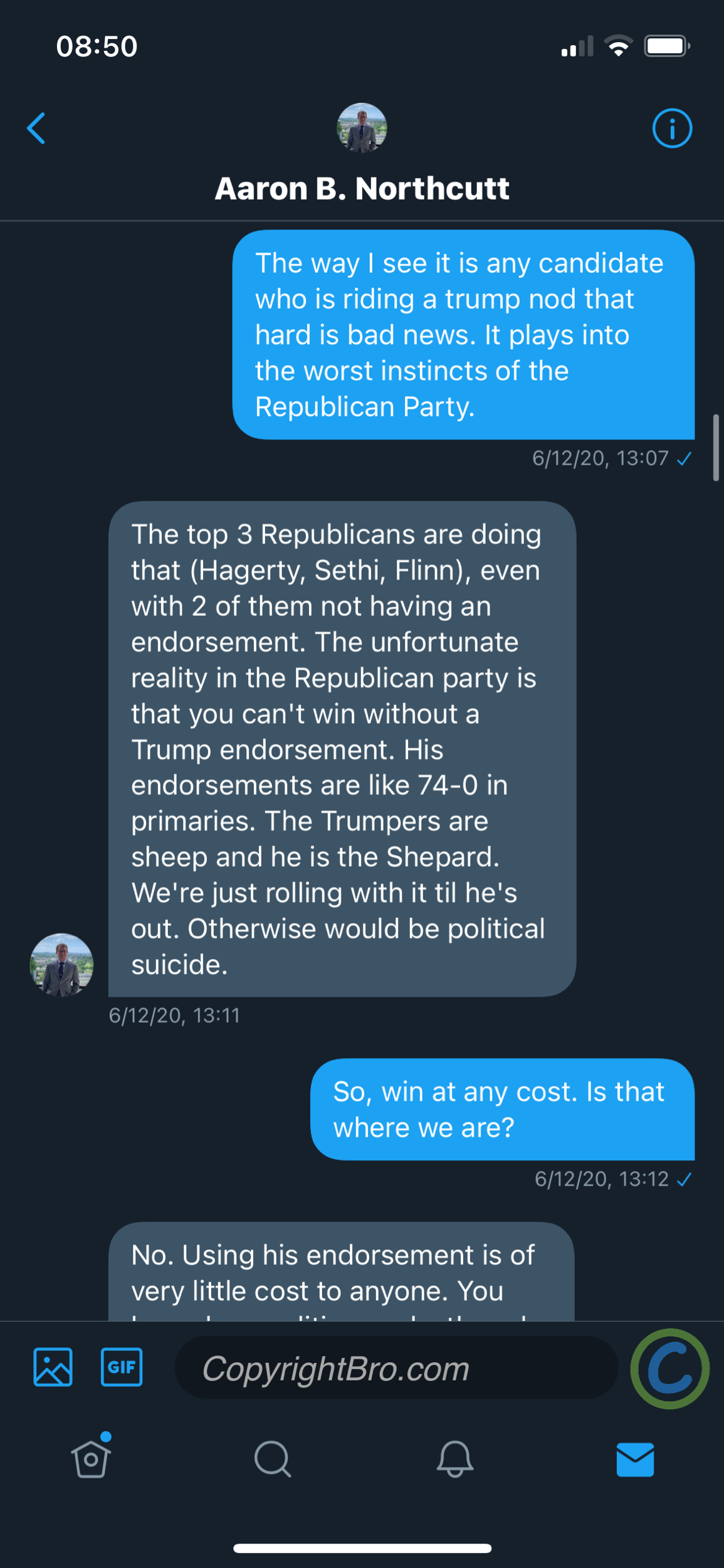
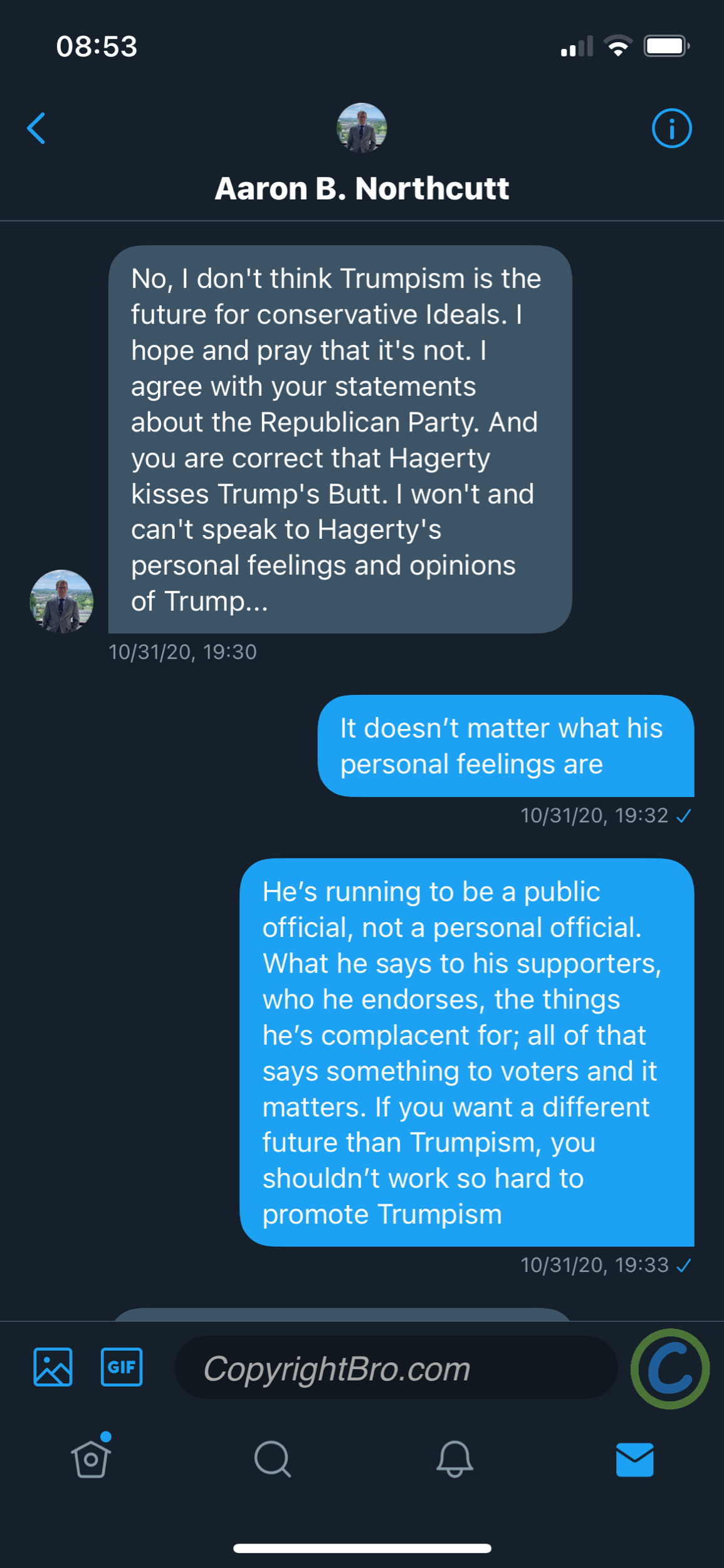
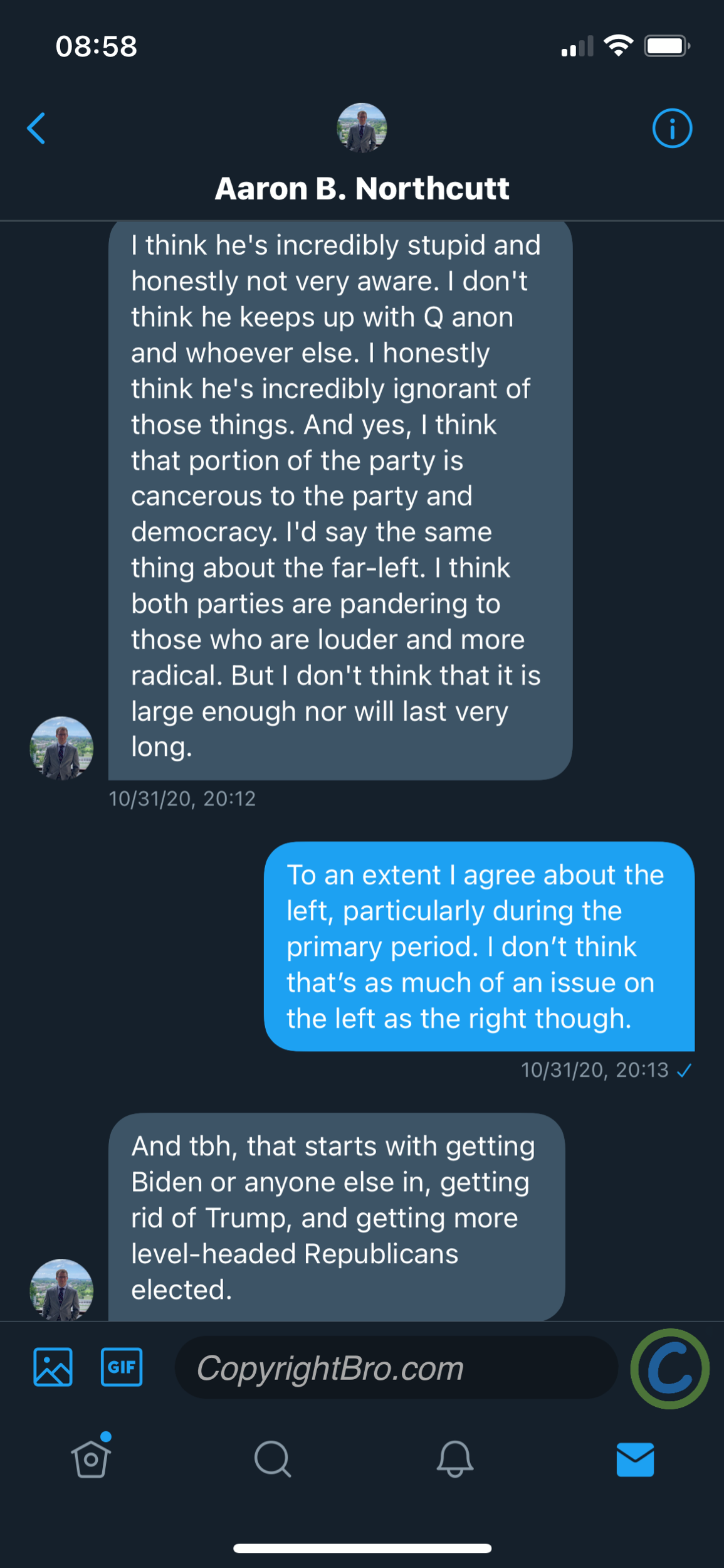
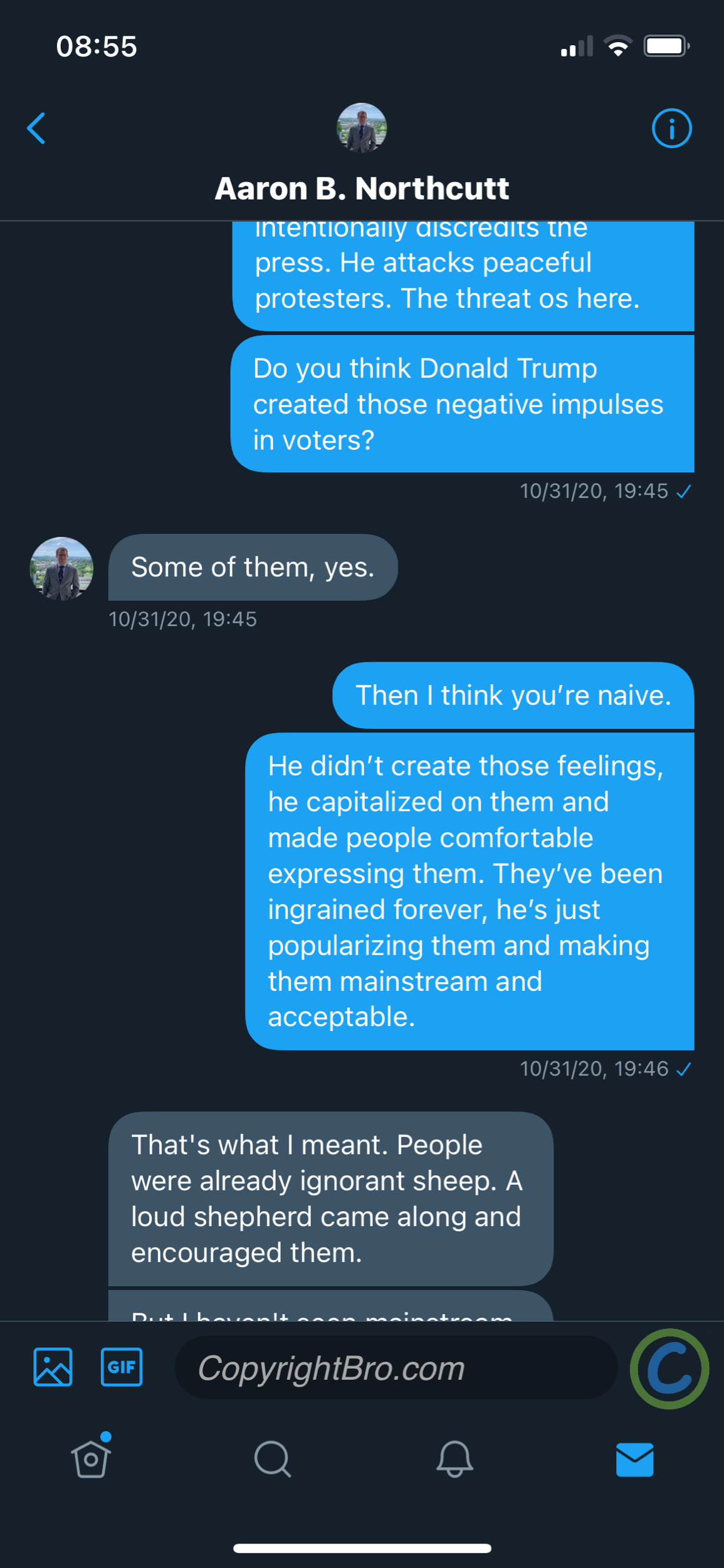
These excerpts from my conversations with Northcutt put on display the worst, most corrupt instincts of the Republican Party. Despite the fact that Hagerty ran as a Trump Republican, it’s clear that that’s not truly the line of thinking he subscribes to, and nor do his staffers. If I were a Trump supporting Tennessean who voted for Hagerty, I would feel insulted and betrayed by these statements.
This concept of Republican congressional candidates riding Trump’s coattails while actually disagreeing with his policies and being disgusted by the way he treats people is not new, and it isn’t unique to Tennessee; in fact, it seems to span across Republican politicians from a variety of backgrounds, from veterans to businessmen, and from reliably red states to swing states. In October, CopyrightBro reported that Chris Taylor, former U.S. congressional candidate from Arizona, was pressured to get on board with Trump’s divisive messaging, despite personally feeling that Trump was a cancerous force to American democracy. However, the differences between Taylor and Hagerty couldn’t be more stark: Taylor publicly endorsed Joe Biden, while Hagerty is hoping his voters aren’t observant enough to recognize that he’s double crossed them.
During my senior year at the University of Tennessee, my tendency to be a bit bold kicked up a lot of dust with the student government crowd, and when I had the opportunity to sink the ship of one of the worst campaigns, I took it.
The “Tennessee Way” campaign was easily the most annoying of the four campaigns vying for control of the (largely useless) student government, relying on a series of Trumpian candidates who were clearly unqualified for any sort of leadership positions and frankly just unintelligent. Their decidedly conservative posture had them poised to coast into the three highest offices (President, Vice President, and Student Services Director) and sweep a lot of the senate seats, while the three more liberal campaigns were cannibalizing one another’s support.
I was leaving UT soon and I had a bit of a chip on my shoulder when it came to SGA (after getting involved myself, I found it to be a way for overly ambitious college kids to pad their resumes without actually having to accomplish anything, though campaigns will occasionally stumble into a situation where they can affect change), and I was in a unique position to neuter the Tennessee Way campaign and make way for a more honest campaign to come in.
I had been involved in a months-long casual relationship with one of the young men at the very top of the Tennessee Way’s ticket. Personally, he was an arrogant dick, and I told him as much on a few occasions, but our arrangement scratched an itch for both of us (what can I say, I was a 22 year old guy in college). Occasionally, he and I would have more mundane conversations before or after our meetups, and he would often talk about how the campaign was going. I couldn’t have been less interested in his faux political wins and woes, but his arrogance was his fatal flaw and I was able to play him like a fiddle: I pretended to find his dramatic campaign stories fascinating, and he would absolutely gush, often indiscriminately. On multiple occasions in person and in writing, he told me about how he had offered multiple campaigns blank checks to allow him to run for one of the big three spots at the top of their ticket. The first campaign to which he made this offer refused. The second campaign to which he made this offer accepted, and that was the Tennessee Way.
I sat on that information for a while, but after a bit of time and a lot of inflammatory, Trumpian rhetoric from the Tennessee Way campaign, and approximately a week before the election, I met with the SGA Election Commission to show them screenshots of my conversations with the young man who made the offer. They approached the Tennessee Way campaign for an explanation, and when faced with the irrefutable evidence that the names at the top of their ticket had bribed each other to the tune of $2000, the entire campaign dropped out of the race within hours.
And in the words of Marty Huggins, “and that’s my story!”
My remarks from five months ago are very applicable again today:
Usually when Taylor Swift is gearing up to drop a new single, she always drops little breadcrumbs and Easter eggs for fans to collect and theorize about what they could mean and whether they’ll lead to new music, but this time, there was none of that. Not only were there no signs of a single, we’re getting an entire album. And we’re getting it at midnight TONIGHT. As a big Taylor Swift fan, it’s pretty safe to say I was blindsided but thrilled by this announcement.
It’s really interesting that she turned this around and surprised us again. This time, there was a sign or two that we could’ve picked up on, but I think most people assumed any hints were referring to her process of re-recording her first six albums. I’m curious to see if these songs were written at the same time as “folklore”, or if they came after “folklore” was finished. It’ll also be interesting to see if any of the stories from ”folklore” are continued in “evermore”.
Last time I correctly predicted that at least one song on “folklore” would prominently feature a harmonica, but this time I’m feeling violins and maybe a harp. We’ll see.
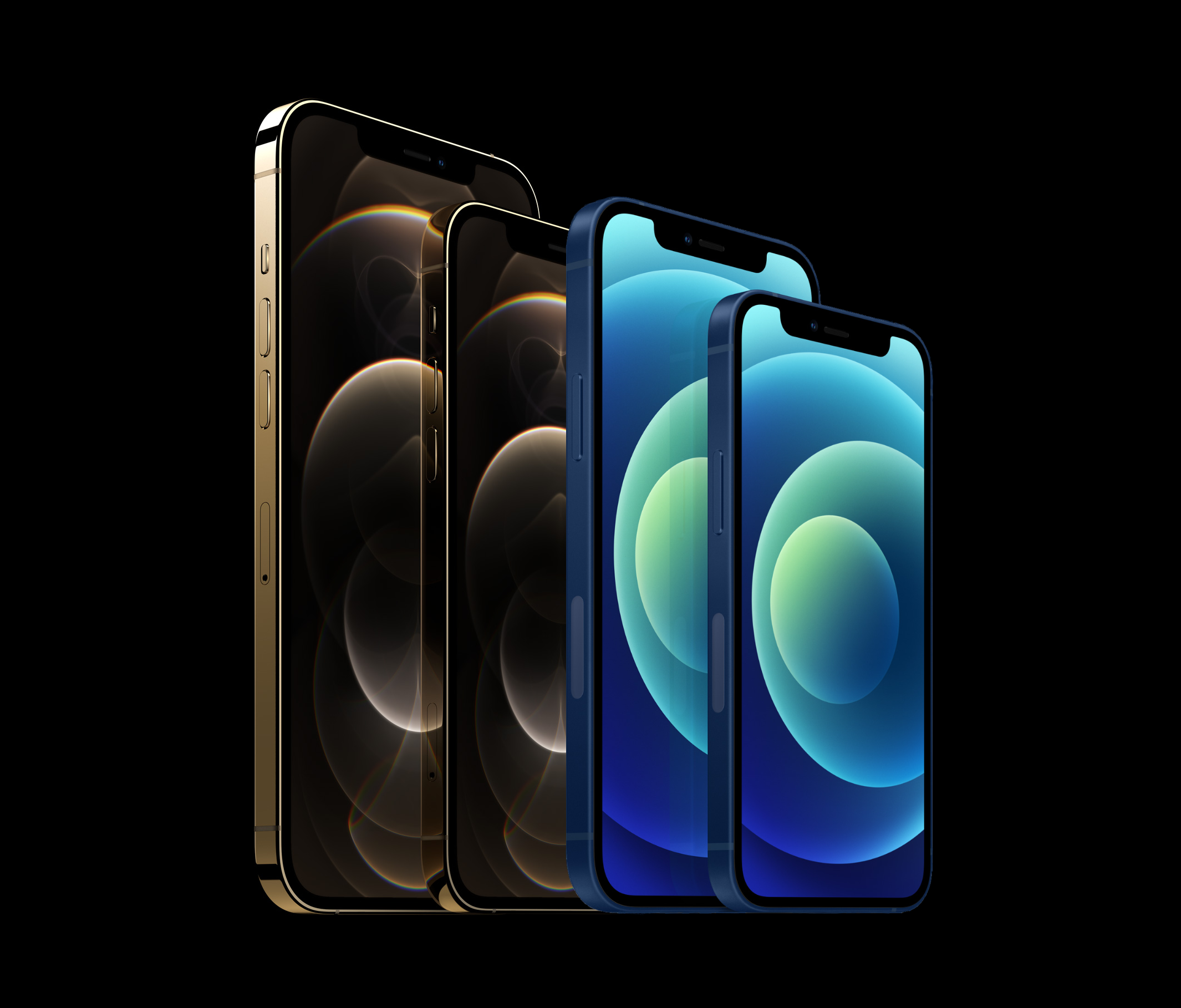
Apple announced four new iPhone models at their event in October, and they’re all very similar to one another. The easiest way to think of them is in two distinct groups: the 12 series (which consists of the iPhone 12 mini and the iPhone 12), and the 12 Pro series (which includes the iPhone 12 Pro and the iPhone 12 Pro Max).
We’ll break down thew differences between these models, but first, it’s important to understand what they all have in common. There are three tentpole features that define the new iPhones, and they are the newdesign, the new processor, and 5G. In each of these areas, the new iPhones are all identical.
All of the new iPhones feature:
A new design. The form factor finally got a nice upgrade, having remained basically the same since the iPhone 6. This years models feature squared off edges, similar to the current iPad Pro models. It’s reminiscent of the iPhone 5, but a little more premium. They also have stronger glass on the front, which is supposed to be up to four times more shatter resistant.
Apple’s brand new processor, the A14 chip. The A14 is an absolute powerhouse that is faster than a significant number of PC laptops. These phones are fast, and they will be fast for years.
5G connectivity. While Apple spent a lot of time talking about 5G at their event, it’s not all its cracked up to be. Most people will notice a slight speed increase (roughly 20%) when doing things over a cellular connection like opening web pages or downloading apps. Still, it’s not a bad thing to have.
The iPhones 12 have the exact same camera system, featuring two sensors (the normal camera and the ultra wide camera). These cameras are both improvements over the cameras in last years iPhones, but the differences are subtle. The iPhone 12 mini is the smallest X-class iPhone Apple has made (X-class, referring to the fullscreen design with Face ID and no Home button) with a 5.4” OLED display. The iPhone 12 is a 6.1” OLED display, but is otherwise exactly the same as the iPhone 12 mini. Both of these phones are solid upgrades over last year’s iPhone 11 models, and the new design makes them feel much more premium. They come in five colors, and they all look pretty nice (though I’m personally not a huge fan of the green).
The bang for your buck is strongest with these two models, and the only questions you need to answer here is which size you want and how much storage you need. For the vast majority of people, one of these iPhones would be a perfect choice.
Yours truly, from my pre-event thoughts: “I’m not a huge fan of massive phones, but I am a huge fan of great cameras, and with four new models, that doesn’t seem like a compromise I should be forced to make.”
Unfortunately, Apple does expect you to make that compromise this year, because only one model features the best camera system, and it is the iPhone 12 Pro Max. There are a few notable camera differences between these models and I’ll flesh them out below, but aside from the cameras, the battery life, and the size, they’re identical. A quick note on colors, though: these phones come in four colors: silver, gold, graphite, and pacific blue. I was excited for the pacific blue color and had hoped it would be a sort of metallic navy, but in person it was more of a shimmery, bluish teal, so I decided to go with a graphite model. It’s also worth pointing out that the stainless steel sides on the Pro model are absolute fingerprint magnets, and am constantly wiping the phone down to get rid of them.
iPhone 12 Pro
The biggest reason for my choosing this model was the third camera lens, which is its only real advantage over the iPhone 12. While the iPhone 12 has the normal camera lens and the ultra wide camera lens, the iPhone 12 Pro adds the telephoto lens which allows you to zoom in twice as far without losing any image quality.
iPhone 12 Pro Max
The iPhone 12 Pro Max has a 6.7” OLED display, and the same stainless steel and glass design of the 12 Pro. However, it does have the best camera by several metrics, though these improvements are mostly unnoticeable except for in situations with relatively low light where you’re trying to photograph a moving subject. The most attractive camera feature of the 12 Pro Max, to me, is the increased optical zoom of the telephoto lens, which is 2.5x instead of 2.0x. The primary camera also has some improvements, including a larger sensor and better image stabilization technology that moves the sensor as opposed to the lens, and these changes result in faster shutter speed, contributing to the 12 Pro Max’s better moving subject/low light performance.
I personally don’t feel like these changes are worth dealing with the increased size, and I sincerely hope that they stop the fragmentation between pro model camera systems in future years. I opted for the iPhone 12 Pro.
This is not my point, and I don’t remember who said it first, but Apple doesn’t have a great track record with getting proprietary connectors off the ground, and I wonder how successful MagSafe will be in the long run. As it currently stands, I like having MagSafe for iPhone, but it’s not exactly a game changer.
I’ve tried the most common MagSafe accessories, and they’re a mixed bag.
Let’s get this one out of the way: the wallet sucks. The magnets are no strong enough to hold it firmly on the phone, and this was particularly a problem with the frosted glass back of the Pro models. Retrieving a card requires you to remove the wallet; the magnets are not strong enough for you to get one out while leaving it attached. For $60, I was very disappointed with the wallet.
The phone case is an easy one. It’s a nice phone case, but MagSafe is practically useless. It’s not the magnets that attach the case, as some thought, its just the physical design of the case wrapping over the edges of the phone enough to stay attached. The only thing MagSafe does here is give you a little on-screen animation, color matched to the case when you first attach it.
Now, the MagSafe charger. This is certainly the best use of the MagSafe technology, and it is convenient that it lines it up perfectly for you. However, the situation with the charging brick is absurd, and for $40, they should really include the power adapter. I get not making being able to make it charge at the full 15 watts with an adapter below a certain threshold, but you would think that chargers above that threshold would still function properly and that isn’t the case. I used the MagSafe puck with my 61w MacBook Pro power adapter, and it charged incredibly slowly, far below the advertised 15w with the 20w adapter. That whole situation is just a mess. On another note, it should also come in a longer length; if they want people to use it while its connected, three feet is not nearly enough.
The ideal MagSafe product would’ve been if they could make this puck also charge the Apple Watch (I realize their discrete charging systems, but they seemingly had figured out how to get close to making it work with AirPower), and in a perfect world, it would’ve been a great little base for the HomePod mini (throw a thick battery in that sucker and give us a couple hours of unplugged playback).
I liked the size of the 12 mini a lot. If they made a Pro model that size, it would be very tempted to go for that one. I think my ideal device would be a Pro-level phone with a size somewhere between the 5.4” mini and the 6.1” Pro.
All in all, these iPhones are exciting because they look fresh. If you have last year’s models, you don’t really need to upgrade unless you’re just ready for something that looks a bit nicer and some incremental improvements. If you have an iPhone from 2018 or before, you’ll be really impressed by these devices.
It seems like the U.S. is just a few days away from rolling out the first COVID-19 vaccine. I’m not an anti-vaxxer by any stretch of the imagination (gets your kids their shots), but something about this vaccine process just isn’t sitting quite right with me. In all likelihood, and hopefully, this post won’t age well, and in a few years we can talk about how silly we were to be worried about it, but as of right now, I don’t want the COVID vaccine.
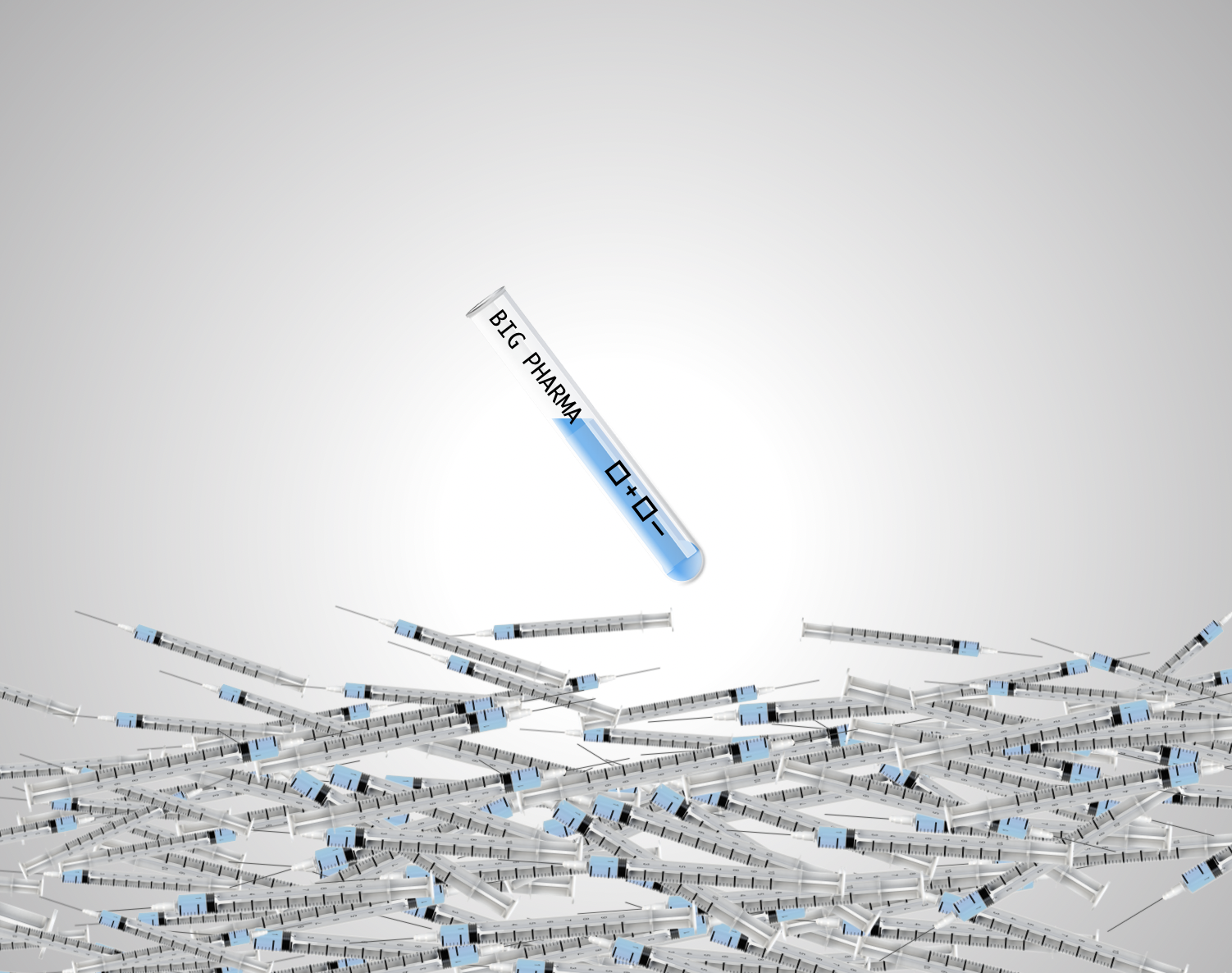
Most of all, I don’t trust big Pharma. They’re one of the most egregiously exploitative industries in world history, and report after shocking report keeps proving this. It sucks that they’re going to reap all the credit and the profit for saving everyone. The opioid epidemic is completely their fault, but now we’re going to act like they’re heroes because they’ve ostensibly concocted a vaccine for a virus that has caused far less death and suffering than the products they’re usually pumping out.
Furthermore, it seems like it happened too quickly and with too much coordination. Back in March, they were predicting it would be at least 12-18 months before we would have a viable vaccine. Now, here we are and multiple companies happened to cut that time in half, making this the most successful vaccine production campaign ever, and they ended up with a finished product that’s 94% effective? It just seems a little too good to be true.
What doesn’t seem too good to be true is the period of time for which the vaccine is effective. Presumably because the COVID-19 virus mutates rather quickly, the vaccine is only predicted to provide about three months of protection. Logistically, if everyone were in line to get the vaccine, I don’t think we’ll have enough to vaccinate everyone in America for many months, given that one vaccination requires two injections spaced a few weeks apart. That means that the number of people who can be vaccinated is half of the number of doses we have. So if everyone has to get back in line for another round of two shots after three months, it seems like we won’t ever catch up unless the companies manufacturing them can miraculously increase their output.
On a different note, some people have had severe allergic reactions to the vaccine, so at what point should we start to wonder about the risks? Not only the short term risks of possible allergic reactions, but what about long term risks? This is a brand new vaccine, we don’t know what long term effects it could have. If you’re an elderly person, there’s a good chance you could die from COVID, so you probably don’t need to worry about long term effects, but if you’re a young, healthy person, you should consider whether this vaccine will do more damage to you in the long run than COVID itself could.
Further contributing to my safety concerns, the Trump administration has hopelessly politicized this process. Their political strategy has been to rely almost entirely on the promise of a vaccine rather than preventing the spread of the virus in the first place, so I don’t exactly trust them to have followed all the necessary safety guidelines. As I said before, this feels like a rush job. Plus, if you wanna talk crazy conspiracy theories, then it’s worth acknowledging that if the government (or a private entity, @bigpharma) ever were going to try to get the majority of the population drinking some kool-aid, this would be the time to pull that lever. I don’t believe that’s what’s happening, but this would be a great opportunity.
I’m not saying you shouldn’t get the vaccine. I’m just saying it’s a decision you need to make carefully, and that we should be asking questions rather than falling in line like sheep.
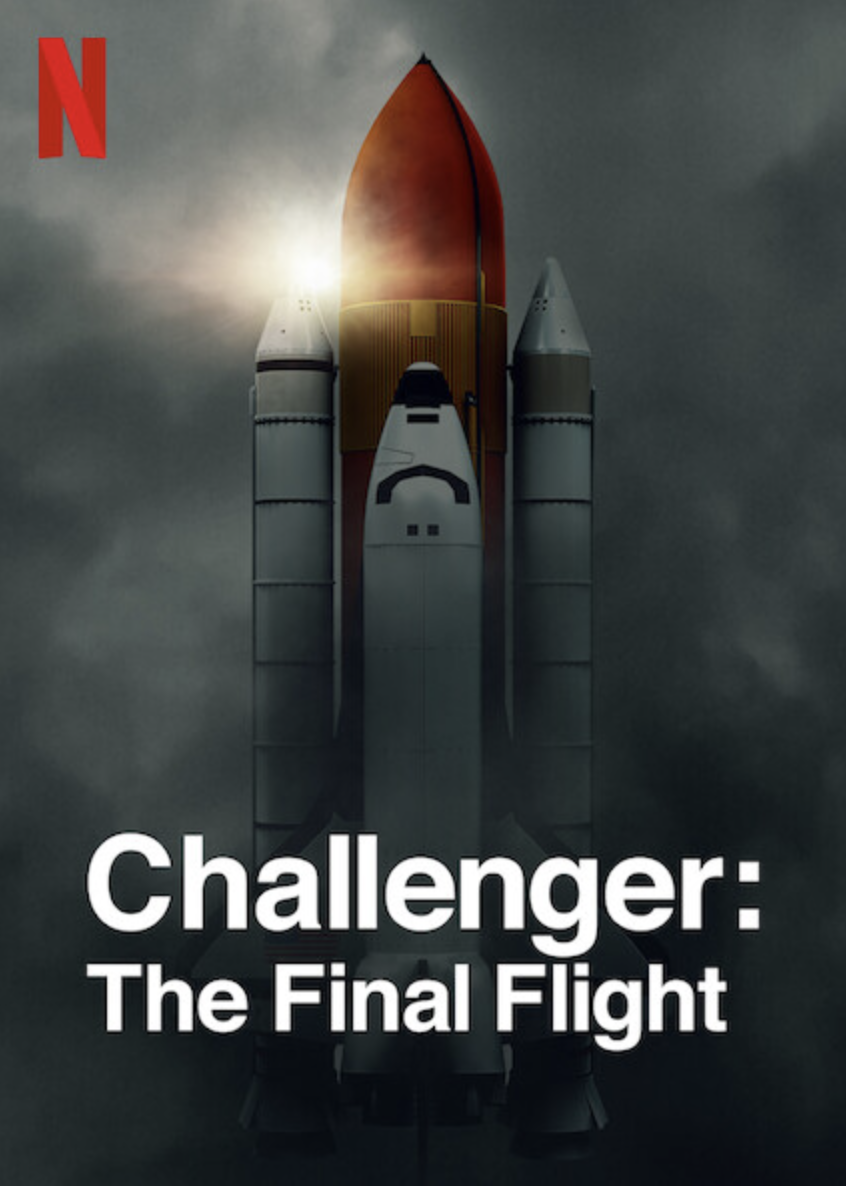
Netflix has a new, four-part docuseries that walks through the Challenger Space Shuttle disaster in an explanatory way while still being respectful of the tragedy of the event. It features a lot of interviews with NASA personnel, as well as heartbreaking accounts from the families of the astronauts who were killed. It’s really interesting and insightful; if you’re interested in the history of the United States’ space programs, or if you just don’t know much about what happened with the Challenger, this docuseries is well worth your time.
A broader societal question occurred to me while I was watching this. American history has no shortage of tragedies, but the ones people tend to obsess over and analyze endlessly (I’m thinking of JFK’s assassination, 9/11, the Challenger disaster, etc.) have something in common. They all feature people dying in violent, gruesome ways, on camera. It makes you wonder.
President Reagan's address to the nation in the aftermath of the explosion actually included a line that is one of my favorite quotes: “The future doesn’t belong to the fainthearted, it belongs to the brave.”
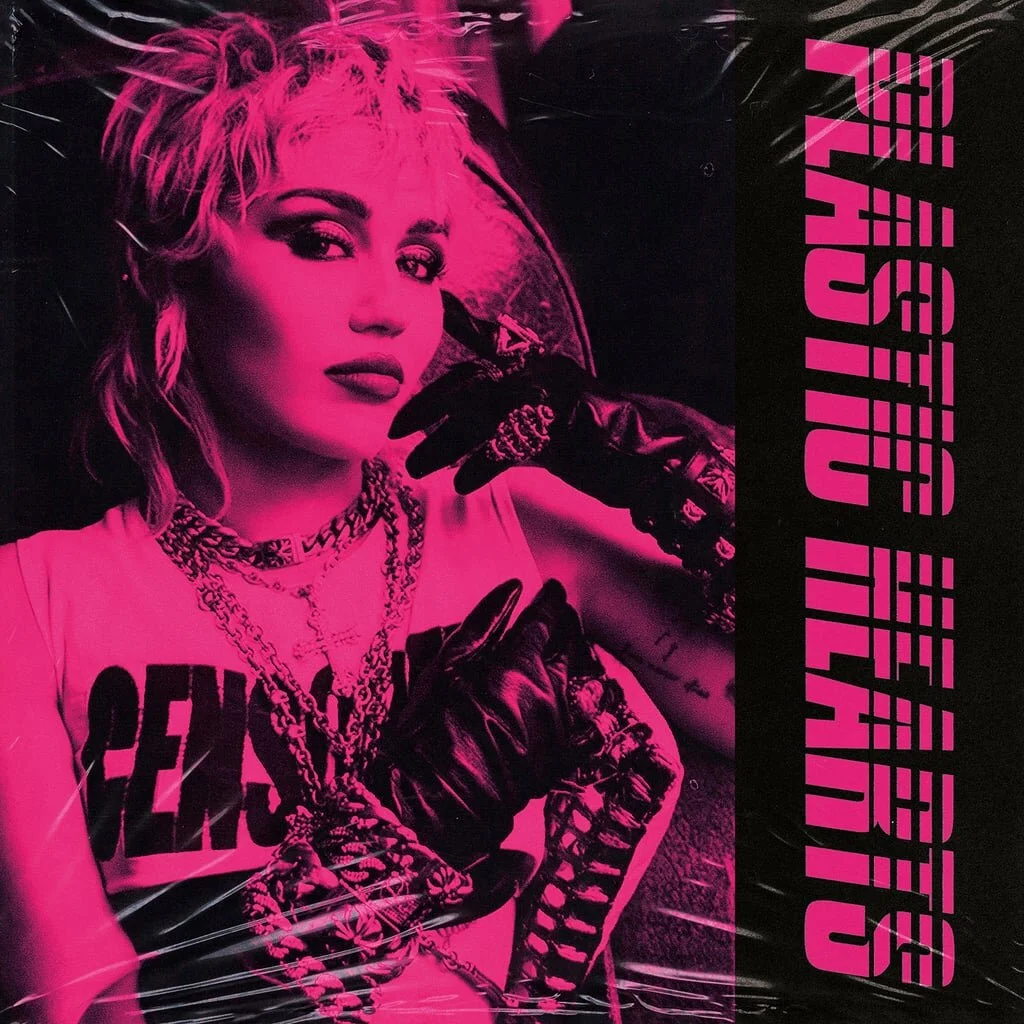
Miley’s new album “Plastic Hearts” is pretty good. It’s got big 80s-rock vibes, and while it’s definitely a new arena for Miley, it still sounds like her. A lot of the songs are rather vulnerable and a little dark, I hope Miley is in a good mental place.
In my opinion, the best tracks are “Plastic Hearts”, “High”, “Angels Like You”, “Golden G String”, and “Hate Me”. I think a couple of them may have the staying power to become truly iconic songs that people will love decades from now, like so many songs from the 80s are. It was really cool that she worked with iconic rockstars for some of the songs too: Joan Jett and Billy Idol made for good collaborators.
The more I listen to this album, the more it strikes me that maybe this isn’t an entirely new sound for Miley. It actually reminds me a lot of what a more mature Hannah Montana might sound like. I don’t think that’s a bad thing at all.
The documents in Anatel state, however, that none of the three devices will be sold with a charger in the box; the headset will also not be included, following Apple's steps with the iPhone.
So predictable, even after Samsung put out ads giving Apple shit for not including a power brick.